

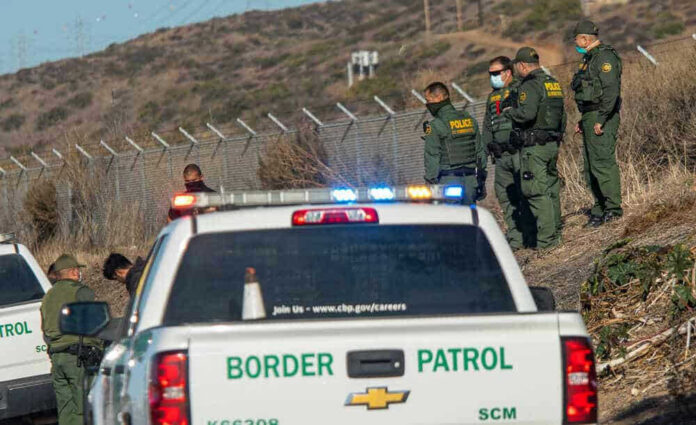
When a man who claims he delivered “the most secure border ever” walks away overnight, the real story is never just about his ranch and family.
Story Snapshot
- Border Patrol Chief Michael “Mike” Banks abruptly resigned effective immediately after just over a year leading the agency.[1][3]
- He framed the move as a long-earned retirement to focus on his family, ranch, and life in Texas.[1][2]
- The exit lands amid a broader Department of Homeland Security immigration leadership shakeup under a Trump administration team.[3]
- The public record offers few hard facts about why, leaving a vacuum that politics will rush to fill.[3][4]
A Sudden Exit From One of Washington’s Toughest Jobs
Michael Banks did not taper his way to the exit. Reports say the United States Border Patrol chief resigned “effective immediately,” after barely more than a year running the green-uniformed force that intercepts people and drugs at the southern border.[1][3]
Television clips described the move as abrupt, not the usual months-long glide path. For a twenty-plus-year veteran who had just climbed to the top job, that timing alone invites harder questions than a polite farewell message can answer.
Banks told viewers and his own agents a simpler story. He said it was “just time” to pass the reins, enjoy family, and return home to Texas to focus on his ranch.[1][2] Local coverage quoted him on life after 37 years in public service, not on policy fights or pressure.[1][4]
On its face, that explanation fits a familiar American script: the cop-turned-grandfather finally stepping off the treadmill. Yet the surrounding facts refuse to stay in the background.
The Broader Shakeup Surrounding Banks’ Decision
Politico reported that Banks’ resignation comes just weeks before acting Immigration and Customs Enforcement Director Todd Lyons steps down and is replaced by former private prison executive David Venturella.[3]
That pairing marks the first big personnel changes in the Trump administration’s immigration team under new Homeland Security Secretary Markwayne Mullin, who himself took over after Kristi Noem’s removal.[3]
When multiple leaders move in quick succession, Americans are right to wonder whether they are seeing normal turnover, a strategic reset, or quiet internal friction.
Coverage from national and local outlets consistently used the language of “resigns,” “steps down,” and “retiring,” not “fired” or “removed.”[1][2][4]
The Department of Homeland Security and the White House did not rush out a long explanation, and one report noted that the White House did not immediately respond to questions about the departure.[3]
That silence leaves space for both sides of the political spectrum to project their favorite storyline, from “routine rotation” to “purge of the insufficiently loyal.”
The Official Narrative: Mission Accomplished, Time To Go
Supporters of the administration’s border posture point to how leadership framed the Banks era. A senior Customs and Border Protection official praised his tenure, claiming the border had been transformed from “chaos” to the “most secure border ever recorded.”[3]
Banks himself described getting “the ship back on course,” then deciding it was time to leave.[3] From that vantage point, his departure looks like a coach retiring after a winning season rather than a mutiny in the locker room.
⭕️ U.S. Border Patrol Chief Michael Banks announced his resignation Thursday after more than 20 years with the agency, telling Fox News he felt he had gotten “the ship back on course.”
His exit is the latest in a series of senior Department of Homeland Security departures,… pic.twitter.com/JOirzIotec
— Drop Site (@DropSiteNews) May 15, 2026
Yet those claims come without hard performance data attached. The record here is press quotes and sound bites, not detailed metrics on crossings, seizures, or cartel disruption.[1][3]
The “most secure ever” line sounds more like a political commercial than a verified assessment. Readers should treat such bragging the way they treat any big-government self-promotion: respect the uniform, but insist on receipts. Patriotism and skepticism can, and should, coexist.
What We Know, What We Do Not, and How to Read the Silence
The strongest evidence for the “nothing to see here” explanation is Banks’ repeated emphasis on family and life after service, joined by multiple outlets that independently described his move as a resignation or retirement, with no allegations of misconduct.[1][2][4]
No public record source has produced a memo, email, or on-the-record complaint linking his exit to a specific policy dispute or scandal. For now, the idea of a dramatic policy protest is speculation, not fact.
The strongest evidence for a more complicated story is structural, not sensational. The resignation was immediate; it landed during a wider immigration-team turnover; and the Department of Homeland Security offered no detailed rationale.[3][4]
That pattern is entirely consistent with a managed “reassignment” culture in Washington, where leaders are encouraged to “decide” it is time to go. Without the resignation letter, internal messages, or testimony from those in the room, citizens cannot know whether Banks jumped or was gently pushed.
Why Ordinary Citizens Should Care About This One Man’s Exit
Border enforcement leadership has become one of the most politicized jobs in the federal government, positioned between local sheriffs, cartel networks, and presidential campaign rallies.[3][4] When a chief in that slot leaves suddenly, the question is not just “Why him?” but “What happens to the mission tomorrow?”
A stable, clearly directed Border Patrol protects both national sovereignty and lawful immigration. High turnover and murky explanations chip away at trust in that mission, especially among border communities who live with the consequences.
American values demand secure borders, transparent government, and a presumption of innocence for individuals absent clear evidence. Applying those values here means two things at once.
First, resist the urge to declare Banks a hero, a villain, or a casualty of a purge when the known facts do not justify any of those labels.
Second, demand better documentation and candor from the government that works for you. Personnel moves at this level are not gossip; they are governance.
Sources:
[1] YouTube – Border Patrol Chief Mike Banks resigns after more than 20-year career
[2] YouTube – US Border Patrol chief Mike Banks resigns after just over a year
[3] Web – Border Patrol chief resigns in latest immigration team shakeup
[4] YouTube – U.S. Border Chief Michael Banks announces resignation