

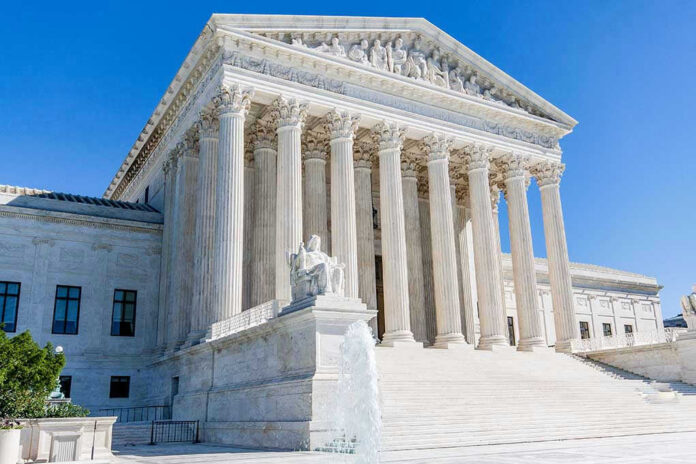
The most powerful court in America just told millions of Virginia voters that their “yes” vote on a redistricting plan does not matter if their politicians broke the rules getting it on the ballot.
Story Snapshot
- Virginia voters approved a new congressional map drawn to help Democrats, but the state’s high court voided it on procedural grounds.[2][3]
- The United States Supreme Court refused to step in, leaving the old districts in place and Democrats furious.[2]
- The fight turns on a dry timing rule about elections that now decides who controls several House seats.[3]
- The case exposes a core tension in American politics: does the rulebook outrank the voters when politicians cut corners?[1][2]
How Millions Of “Yes” Votes Vanished Overnight
Virginia’s story starts like a civics-class success tale. Lawmakers proposed an amendment to the state constitution that would authorize new congressional districts. More than three million Virginians turned out to vote on that amendment, and a clear majority said yes.[1] Supporters promised the map would correct what they saw as Republican-friendly gerrymanders in states like Texas and Florida and give Democrats a fairer shot in a closely divided House of Representatives.[3] Then the courts arrived.
Not long after the vote, the Supreme Court of Virginia examined how the amendment reached the ballot and dropped a legal hammer. In a four-to-three decision, the court held that the Democratic-controlled General Assembly violated the state constitution’s required process for placing amendments before voters.[2][3]
The legislature, the court concluded, started and finished key steps after early voting for the general election had already begun, breaching a timing rule baked into the constitution. That defect, the court said, tainted the referendum so badly that the amendment was “null and void.”[3]
BREAKING: The Supreme Court rejects Virginia's bid to restore a congressional map favoring Democrats. https://t.co/WrcexMohCv
— The Associated Press (@AP) May 15, 2026
Why The United States Supreme Court Walked Away
State Democratic leaders refused to accept that outcome quietly. Virginia’s attorney general Jay Jones, House Speaker Don Scott, and top Democratic senators raced to the United States Supreme Court, asking for emergency relief.[1] They argued that the state court had “overstepped its authority” and effectively erased the votes of millions of Virginians, misreading federal rules that set a single Election Day.[1] In their view, early voting is just that—early—and not part of the “general election” for timing purposes.
The United States Supreme Court’s answer came in a single, unsigned sentence: request denied.[2] No justice noted a dissent. The one-line order left the Virginia Supreme Court’s ruling fully intact and guaranteed that the old congressional map stays in place for the upcoming midterm elections.[2] The high court signaled what conservative lawyers have argued for years: federal judges generally will not rescue state politicians from their own state constitutions, especially on a rushed emergency docket.
Procedure Versus Populism: Which One Wins?
Democratic officials and activists responded with outrage. They insist that when more than a million Virginians vote for new rules, courts should respect that expressed will unless something flagrantly illegal occurred.[1]
They frame the timing issue as a technicality weaponized to protect Republican-tilted lines, pointing out that the new map would likely have given Democrats a chance to pick up four seats in the United States House of Representatives.[3] To them, letting a procedural misstep erase that choice looks like judicial activism in defense of partisan advantage.
Defenders of the ruling counter with a simpler principle: the rules matter more than the result. The Virginia Constitution sets a specific sequence for how amendments and election questions must move from legislature to ballot.[2][3] If lawmakers short-circuit that process—especially during a special session and after early voting has begun—they are asking for trouble.
From this view, allowing a procedurally tainted referendum to stand would reward politicians for gaming the calendar and would invite more creative shortcuts next time.
What This Fight Reveals About Power And Common Sense
Redistricting always attracts power plays, but this case strips the fight down to a core question that resonates with common sense: should process be flexible when it benefits your side, or must it stay fixed regardless of whose ox is gored?
National outlets openly described the rejected map as designed to “advantage” Democrats and to serve as a partisan answer to Republican gains elsewhere.[2][3] That framing weakens the claim that this was a neutral reform effort about fairness rather than a targeted attempt to lock in more blue seats.
At the same time, those who cheer the outcome might ask themselves how they would feel if Republican leaders in a different state tried the same procedural shortcut. If courts allowed it because the policy result looked attractive, the precedent would haunt everyone later.
The Virginia case underscores a hard truth: real self-government requires both majority rule and faithful obedience to the written rules. When politicians ignore that second half, courts will eventually remind them that even three million “yes” votes cannot fix a broken process.
Sources:
[1] Web – Supreme Court refuses to restore Virginia redistricting plan …
[2] Web – Supreme Court rejects Virginia Democrats’ bid to revive … – CBS News
[3] YouTube – Virginia Supreme Court strikes down gerrymandered redistricting plan