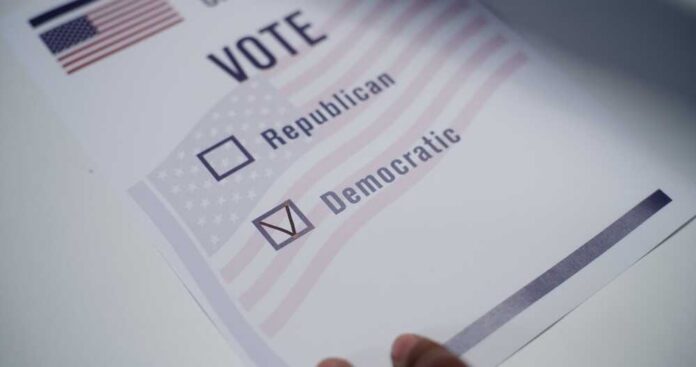
The Supreme Court just told America something simple and explosive: Election Day ends when voters stop voting, not when the mail finally shows up.
Story Snapshot
- The Court ruled 5-4 that states may count ballots arriving after Election Day if they were mailed on time.
- The decision rejected a Trump-backed push to force a hard Election Day receipt deadline nationwide.
- Justice Amy Coney Barrett said federal law sets the voting day, not the day ballots must be received.
- The ruling protects millions of lawful votes from military, overseas, and rural Americans who rely on slow mail.
The narrow legal question that blew up a national fight
Justice Amy Coney Barrett framed the case as a narrow question: does federal law about Election Day override a Mississippi rule that accepts mail ballots for five business days after the election if they are postmarked by Election Day. Her answer was direct.
The federal statutes say when Americans vote, not when the envelope has to land on a clerk’s desk. That means states retain the authority to set receipt deadlines, including short grace periods tied to postmarks.[13][17]
Justice Samuel Alito saw the same words and drew the opposite line. He argued that accepting late-arriving ballots “effectively postpones the date on which the electorate’s choice is made,” insisting Election Day is a single, fixed date and not “a span of multiple days.”
That is the core fear on the conservative side: once counting includes mail that arrives later, people will believe the election itself stretches on and becomes easier to manipulate. For many voters, that concern fits a deeper worry about trust and fairness.[17]
Trump’s push for a hard deadline confronts the facts on the ground
The challenge to Mississippi’s law was part of a broader Republican effort, personally backed by Donald Trump, to end all grace periods for mailed ballots and make Election Day the universal receipt cutoff.
Trump has promoted federal legislation, including the Save America Act, aimed at banning the counting of any ballots that arrive after Election Day, even if mailed on time. Supporters frame this as common-sense election integrity. They say that late ballots invite fraud and tilt results toward Democrats.[1][9]
But courts and researchers keep asking for proof and not getting it. Multiple investigations into the 2020 election, plus dozens of lawsuits, found no evidence of widespread fraud connected to mail voting.
A major study cited in the record found only a handful of confirmed mail-ballot fraud cases among millions of votes. That does not mean fraud can never happen, but it does mean the “late ballots equal cheating” claim rests more on suspicion than documented cases.
Why the ruling matters for everyday voters, not just lawyers
This case was not abstract to the voters whose ballots show up late. Mississippi’s law, like laws in more than half the states, protects people who mailed their ballots on time but were affected by postal delays.
That includes military members stationed abroad, Americans living overseas, and rural voters far from drop boxes and local offices. Barrett’s opinion echoed a simple principle that reflects basic fairness: if a lawful voter follows the rules and casts a ballot by Election Day, the system should count it.[1][16][17]
Real-world data shows how deadlines can quietly erase legal votes. One study of mail voting in Pennsylvania estimated that an Election Day receipt rule deterred about 11,000 people from voting because they knew their ballots would likely arrive late and be rejected.
Ballotpedia’s review of 2024 found more than half a million absentee or mail ballots were rejected nationwide, often for technical reasons like lateness or signature issues.
For Americans who value personal responsibility, these voters did what was asked of them yet still lost their voice due to bureaucracy and postal timing.[20][21]
Election integrity, media framing, and the conservative dilemma
Media outlets quickly cast the decision as a “big win for democracy” and a defeat for Trump’s fraud narrative. That framing feeds into a broader storyline: one side says it defends democracy by expanding access, while the other is portrayed as trying to shrink the electorate for partisan gain.
For many right-leaning Americans, that feels unfair. They see real risks in loose systems, sloppy voter rolls, and weak identification rules, even if mass fraud has not been proven.[1][17]
The Supreme Court on Monday ruled that states can count late-arriving mailed ballots, rejecting a Trump-led challenge. https://t.co/yCB9tZVfr0
— FOX 13 Seattle (@fox13seattle) June 30, 2026
On one hand, a clear, uniform Election Day deadline sounds clean and orderly. On the other hand, a government that throws out on-time ballots because the post office was slow looks like a government that breaks its promise to its own citizens.
The Supreme Court did not say every state must have grace periods. It said Washington cannot stop states from choosing them. That leaves the real fight where it belongs: state houses, not courtrooms.
Sources:
[1] Web – Supreme Court rules states can count late-arriving mailed ballots, …
[3] Web – U.S. Supreme Court rejects Trump-led challenge against mail-in …
[9] Web – Supreme Court rules states can count late-arriving mailed ballots …
[13] YouTube – Supreme Court upholds Mississippi mail-in ballot law
[16] Web – The Supreme Court on Monday upheld a Mississippi law that allows …
[17] Web – How many voters could be affected by earlier mail ballot deadlines …
[20] YouTube – Potential legal challenges over late-arriving mail ballots
[21] Web – Election results, 2024: Analysis of rejected ballots – Ballotpedia
[22] Web – Measuring lost votes by mail – PMC – NIH