A 41-year-old father collapsed inside a New Jersey immigration jail, and what happened next now defines a fierce battle over life, death, and government duty.
Story Snapshot
- Edwin Lopez-Cornejo, a Salvadoran migrant, died after a reported medical emergency while in federal immigration custody at Delaney Hall in Newark.
- Immigration and Customs Enforcement (ICE) says staff responded immediately and that he received proper medical care before he was pronounced dead at a hospital.
- Family members and civil rights advocates say he had serious health problems and accuse the facility of denying needed medication and humane treatment.
- His death is the second at Delaney Hall in less than a year, raising sharp questions about medical care at Trump-era immigration detention centers.
A medical emergency inside Delaney Hall ends in a hospital death
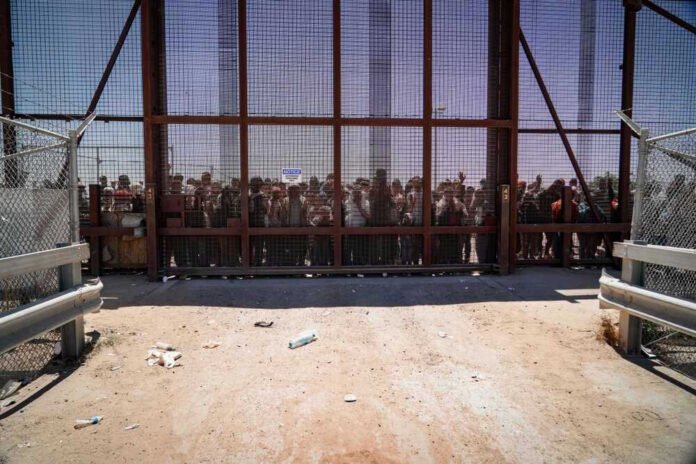
Federal officials say the crisis began inside Delaney Hall, an immigration detention center in Newark that contracts with the government to hold noncitizens awaiting removal.
Immigration and Customs Enforcement (ICE) reported that Edwin Lopez-Cornejo, a 41-year-old citizen of El Salvador, “experienced a medical emergency” while in custody on August 1.
Staff from the GEO Group, which runs the facility, and on-site medical workers responded and called 911 for emergency medical services, according to ICE’s statement.
Emergency crews took Lopez-Cornejo to University Hospital in Newark, where medical staff pronounced him dead the same day.
ICE’s public account stresses that he “received proper medical care and was seen by medical professionals” while detained, and that at no time are detainees denied emergency care. The official cause of death remains under review by medical examiners, so there is not yet a final ruling on exactly why his heart stopped.
Who Edwin Lopez-Cornejo was and why he was in custody
ICE records show Lopez-Cornejo first entered the United States illegally without inspection in 2006, when Border Patrol agents arrested him near the southern border.
A federal immigration judge ordered him removed that year, and he was deported back to El Salvador. At some unknown point, he crossed the border again and returned, settling in Plainfield, New Jersey, where local reports say he lived for about two decades and became part of the community.
A Salvadoran migrant who was in Immigration and Customs Enforcement custody in New Jersey died following a "medical emergency" over the weekend, federal officials said Monday.https://t.co/rMUlsHdSGX pic.twitter.com/M8kSAkdkC9
— Eyewitness News (@ABC7NY) August 4, 2026
On June 18, 2026, ICE officers arrested him in Plainfield. Because of his prior removal order, officials placed him in detention while they moved to reinstate that order and deport him again.
He was sent to Delaney Hall, a privately run facility that holds immigration detainees under a federal contract and has become a symbol of President Trump’s tougher immigration enforcement, backed by a multibillion-dollar budget for ICE. His mother says he was also a father to a 12-year-old girl, who never got to visit him before he died.
Family’s account and advocacy claims of denied care
Lopez-Cornejo’s mother, María, quickly challenged the official picture once she learned her son was gone. In interviews shared by labor and immigrant rights groups, she says the hospital called to tell her Edwin’s heart was not beating when he arrived.
She describes a son with diabetes and epilepsy, taking medication for diabetes, high blood pressure, and seizures, and says he depended on those drugs to stay alive and stable.
Advocacy posts and local reporting relay her claim that he did not receive some of his needed medication during about six weeks in detention at Delaney Hall. Activists frame his death as “preventable medical neglect,” arguing that a man with known chronic illnesses should never collapse unnoticed in a controlled facility.
The American Civil Liberties Union of New Jersey echoed that concern, saying his death reportedly followed a failure to provide adequate medical care and pointing to “routine denial” of proper care and basic conditions in immigration detention.
Officials demand answers as Delaney Hall faces scrutiny
Edwin’s death did not occur in a vacuum. In December, a Haitian man named Jean Wilson Brutus died shortly after entering Delaney Hall, with ICE describing that case as suspected natural causes following a medical emergency.
That earlier fatality had already fueled protests and doubts about how detainees are treated during medical crises. Now, two deaths in less than a year at the same site have drawn sharp public attention.
On August 1, 2026, Edwin Lopez-Cornejo, a 41-year-old Salvadoran migrant, died after experiencing a medical emergency while in ICE custody at the Delaney Hall Detention Facility in Newark, New Jersey. His death has intensified fierce local protests and legal battles surrounding…
— Leinona Aoki (@LeinonaA69) August 4, 2026
Members of New Jersey’s congressional delegation and local officials quickly weighed in. Representative Rob Menendez said he learned Lopez-Cornejo complained of difficulties on the day he collapsed, that cardiopulmonary resuscitation was performed at Delaney Hall, and that emergency medical services transported him to the hospital, where he was declared dead.
Newark Mayor Ras Baraka and Senator Andy Kim both called the death heartbreaking and said the family and community “deserve answers,” citing Delaney Hall’s history and the need for stronger oversight.
A larger pattern of death and distrust in immigration detention
This single death sits inside a broader record that should concern anyone who believes government power comes with a duty of care. Civil rights groups have tracked dozens of deaths in immigration custody in recent years, and the American Civil Liberties Union’s report “Deadly Failures” describes repeated cases where detainees with chronic illnesses deteriorated behind bars.
The report argues that federal detention standards often look strong on paper but break down in practice, especially around timely access to doctors, medication, and emergency response.
That pattern explains why many Americans who value limited but accountable government bristle at vague phrases like “medical emergency.” The state holds total control over a detainee’s environment, schedule, and access to care.
When a person dies in that setting, it says the burden rests on officials to show that they met a clear, concrete standard of care. Agency assurances that everyone “received proper medical care” sound thin without public medical records to back them up.
What needs to happen next to honor life and enforce the law
President Trump’s tougher immigration policies have strong support from many Americans who want secure borders and clear rules. But tough enforcement does not excuse sloppy custody.
The core idea is simple: the same government that locks you up must also keep you alive unless a court has imposed a different penalty. Immigration detainees are not serving criminal sentences; many, like Lopez-Cornejo, face civil removal based on prior immigration violations.
That duty means a few basic steps now matter more than slogans. First, medical examiners must complete and release a full autopsy report that explains how Edwin died and whether earlier treatment could have changed the outcome.
Second, ICE and the GEO Group should provide transparent information on his intake screening, his medication schedule, his sick-call requests, and the exact timeline on the day he collapsed.
Third, elected officials who already conduct “unannounced oversight” at Delaney Hall need the power to demand reforms if the facts show failures.
Reasonable Americans can support strong borders and still insist that a father with diabetes and epilepsy is never left to crash unseen in a government cage.
Until the full record is public, one fact is already clear: when the United States takes a person into its custody, it also takes responsibility for his heartbeat. That is not a partisan claim. That is our basic standard for a country that calls itself civilized.
Sources:
abcnews.com, x.com, koco.com, facebook.com, assets.aclu.org, nytimes.com, aila.org, instagram.com, thegrio.com, insidernj.com, foxnews.com