

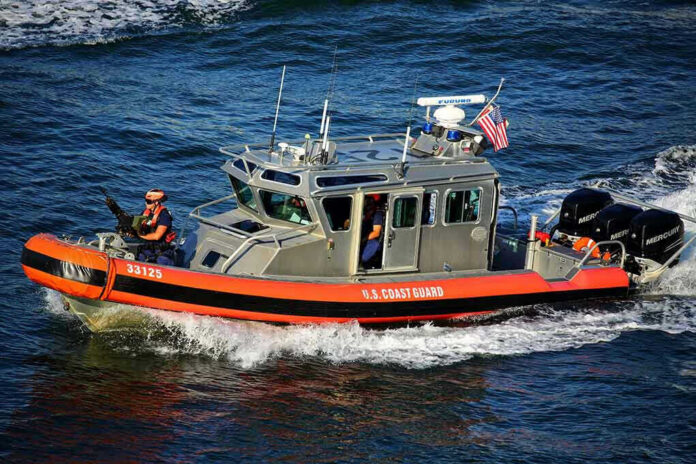
An 86-year-old sailor and his dog were plucked from the Pacific after two silent months, thanks to a blinking emergency beacon and a textbook rescue chain that stretched hundreds of miles.
Story Snapshot
- A Coast Guard aircraft found the sailboat Willow Wind about 460 miles off San Diego after a beacon alert.
- The voyage began in Astoria, Oregon, bound for Pago Pago, American Samoa, a roughly 5,000-mile route.
- The merchant ship Grand Orion took the sailor and dog aboard after rough seas delayed recovery.
- A Coast Guard helicopter later hoisted them from Grand Orion and flew them toward San Diego.
Beacon, Aircrew, And A Distant Speck On The Pacific
The emergency-position beacon did what it was built to do. A United States Coast Guard aircrew homed in on the signal and found the Willow Wind about 460 miles off San Diego. The boat had left Astoria, Oregon, for Pago Pago, a bold blue-water run for any mariner, let alone an octogenarian. The last contact came on August 20. An overdue report reached authorities on October 24, which framed the search window that followed.
Search planners pushed the alert through the maritime network. The Coast Guard vectored aircraft and directed nearby ships. The Willow Wind’s sail was damaged, according to reports, but the skipper and his dog remained aboard. The signal narrowed the haystack to a box on the chart. A Coast Guard crew spotted the vessel and relayed its location, setting up the next move in a rescue playbook used thousands of times across American waters each year.
A Merchant Ship Answers, Then Waits On Weather
The commercial vessel Grand Orion diverted to help, as maritime law and long tradition demand. The ship arrived around 3:20 a.m., but heavy seas kept the transfer too risky. The crew stood by for hours and kept trying as the conditions eased. By late afternoon, they succeeded. The sailor and his dog were brought aboard around 5:36 p.m., closing the most dangerous gap between a small sailboat and a high steel hull.
Recovery by a merchant ship buys time and stability. It gives a warm space, food, and medical checks while the Coast Guard positions the final lift. This is how big oceans get smaller. The Coast Guard uses emergency beacons, long-range aircraft, and commercial partners to bridge distances that cutters alone cannot cover in time. Federal data show this system fields thousands of cases a year and saves thousands of lives, a reminder that rescue is a daily mission, not a rare miracle.
Hoist, Fly, And Hand Off To Shore Care
A crew from Coast Guard Air Station San Diego launched an MH-60 Jayhawk helicopter for the last leg. The pilots linked up with Grand Orion when it was about 170 miles west of Ventura, California. The flight crew hoisted the man and his dog from the merchant deck and headed for San Diego. Reports said the sailor was weak and had trouble walking but had no major injuries. He was taken to a hospital for evaluation.
An 86-year-old sailor, adrift in the Pacific with his dog, and both of them were pulled out alive.
He left Astoria, Oregon, in August on his sailboat, the Willow Wind, headed for American Samoa. Nobody had heard from him since Aug. 20. Then an emergency beacon went off, and the…
— William Whittington (@WheelerMan) November 1, 2026
The Willow Wind’s planned route, from the mouth of the Columbia River to American Samoa, is long and lonely. The Pacific does not grade on a curve for age or grit. But gear and teamwork even the odds. The emergency beacon alerted the satellites. The Coast Guard plotted the search. The merchant mariners executed a careful recovery. The helicopter team closed the loop. That stack of tools and duty gave an 86-year-old and his dog a ride home.
Why This Rescue Worked And What It Teaches
Three elements drove the outcome: a registered beacon, reliable airborne search, and rapid help from a nearby ship. Each step shaved risk. The beacon turned a vast ocean into a reachable point. The airplane confirmed eyes-on contact. The merchant ship bridged the time until a helicopter could arrive. These are the same layers that make American search and rescue effective far offshore, where every hour is costly and every mile is slow under sail.
Preparedness still matters. A long passage needs spare parts, storm plans, and honest go-no-go calls. Even so, the ocean humbles the best crews. That is why the beacon is a must, not an extra. One button press brought a global system alive and pushed help across 500 miles of open water. Some headlines lean on drama, but the lesson is simple and practical: carry the right gear, register it, and trust the responders to do their jobs.
Human Grit Meets Institutional Muscle
The sailor’s endurance carried him through long weeks without contact. The dog’s presence likely kept morale up. But the save belonged to a larger structure that America funds on purpose. The Coast Guard exists to answer calls like this, every day, without fanfare. The merchant mariners who stopped and stood by showed old-school seamanship. That mix of personal grit and shared duty is the quiet strength that keeps distant seas from becoming final resting places.
Sources:
foxnews.com, people.com, edhat.com