

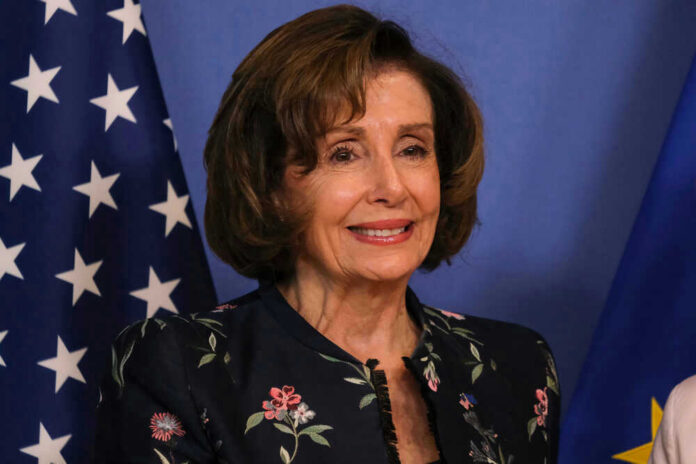
When Nancy Pelosi says a position on Israel is “wrong,” Democrats hear a line being drawn.
Story Snapshot
- Pelosi said comments linked to Zohran Mamdani and Abdul El-Sayed about Israel are “wrong.”
- She added those views do not reflect House Democrats and urged members to disassociate.
- The flashpoint centered on denying Israel’s right to be a Jewish state.
- The clash lands amid a larger Democratic fight over aid and policy toward Israel.
Pelosi plants a flag on Israel and party identity
Nancy Pelosi used a podcast appearance to slam positions tied to Zohran Mamdani and Abdul El-Sayed on Israel. She called the views “more than concerning” and “wrong,” and said they do not represent Democrats in the House. She also signaled members should distance themselves from such claims. Reports describe the exchange as focused on whether Israel has a right to be a Jewish state, with Pelosi rejecting that stance outright.
Coverage of the episode frames the dispute in clear terms. Host Donny Deutsch stated that denying Israel’s right to be a Jewish state is antisemitic, then named Mamdani and El-Sayed. Pelosi agreed the position was wrong. That phrasing gave her critique a tight target: not a policy quarrel over aid or settlements, but the core question of Israel’s Jewish national identity. In party terms, that is a red line rather than a routine policy fight.
Where the record is firm, and where it blurs
The reporting provides Pelosi’s quotes and her claim that House Democrats reject the position. It does not offer full transcripts of the candidates’ original statements. That gap matters. Voters deserve to see exact words, dates, and context to judge fairness. Still, Pelosi owns her assessment and ties it to party identity. Given her long leadership, many will take that as near-institutional guidance, even if it is not a formal caucus vote.
Some outlets also note a twist: Pelosi reportedly urged support for El-Sayed even as she rebuked his Israel stance. That split signals two impulses at once—police the boundary on Israel’s legitimacy while keeping a Democratic coalition intact for November. It is a delicate balance. The move leaves room for critics to ask whether “wrong” views should cost endorsements, or whether party unity outweighs sharp foreign policy lines.
The bigger battlefield inside the Democratic Party
This fight does not sit in a vacuum. Democrats have been fracturing over Israel aid and policy. Nearly half of House Democrats voted to halt aid to Israel during the previous year. Party leaders like Hakeem Jeffries opposed zeroing out aid but said United States policy must change for the good of both Israelis and Palestinians. That creates three camps: reliable backers, conditional-aid reformers, and an anti-aid left.
🚨 Pelosi rips Abdul El-Sayed, says his views on Israel are "more than concerning":
“This new person in Michigan, we’ll see if he gets elected.” pic.twitter.com/zRtjdLvfPx
— Greg Price (@greg_price11) October 30, 2026
Abdul El-Sayed’s on-camera comments add fuel to that split. He argued Israel is not actually a friend of the United States and pushes America toward wars it should not fight. Reports also describe him campaigning against United States military aid to Israel. Those positions challenge decades of bipartisan norms, yet they sit squarely within the live Democratic debate over aid and leverage. They do not, by themselves, assert that Israel should not exist as a Jewish state.
Drawing the conservative common-sense line
Two ideas must be kept separate to have an honest debate. One is policy: how much aid, with what conditions, and what strategy advances United States interests. The other is legitimacy: whether Israel has the right to exist as a Jewish state. Voters can argue the first without touching the second. American conservative values stress moral clarity and alliance reliability. They also value debate on spending and strategy. That means fierce arguments on aid can be fair, but erasing Israel’s Jewish character crosses a bright line.
Pelosi’s words land because they target that bright line. If Mamdani or El-Sayed deny Israel’s right to be a Jewish state, her “wrong” is warranted on both moral and strategic grounds. If their record is narrower—focused on aid or policy—then the door stays open for hard bargaining with an ally. Voters should demand the receipts: exact quotes and dates. Until then, the safest path is this: defend Israel’s legitimacy, keep leverage on policy, and let the facts, not headlines, decide who crossed which line.
Sources:
yahoo.com, nytimes.com, timesofisrael.com, cpr.org, randall.house.gov