

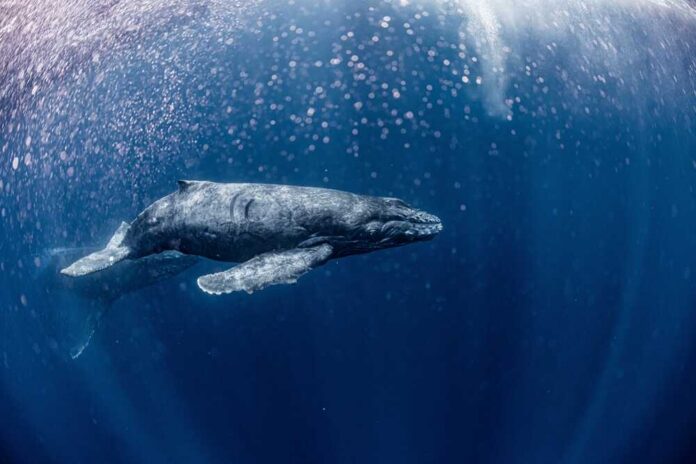
A humpback whale stranded in Germany’s Baltic Sea became the focal point of a dramatic rescue saga that ended in heartbreak, as experts abandoned hope and let nature take its course—a decision that underscores the limits of human intervention when wildlife ventures into inhospitable environments.
Story Snapshot
- 12-15 meter humpback whale repeatedly stranded in the Baltic Sea off the German coast despite initial excavator rescue
- Rescuers abandoned efforts Wednesday, citing the whale’s weakening condition, irregular breathing, and unsuitable brackish habitat
- Scientific coordinator declares the animal will die in the Poel Island inlet as falling water levels trap it permanently
- Humpback whales rarely enter the low-salinity Baltic; experts blame herring pursuit or exploratory migration for fatal detour
Initial Rescue Efforts Prove Futile
A massive humpback whale measuring between 39 and 49 feet first became stranded in shallow waters at Timmendorfer Strand, a Baltic Sea resort along Germany’s northern coast.
Local authorities and firefighters attempted to free the animal by creating waves with boats, but those efforts failed. Rescuers then deployed an excavator on Thursday to dig an escape channel through the sand.
By early Friday morning, the whale swam free through the newly created passage, disappearing from view as rescuers lost track of its movements along the coastline.
Second Stranding Seals Whale’s Fate
The relief was short-lived. By Saturday, Greenpeace confirmed the whale had stranded near Wismar in Mecklenburg-Pomerania, approximately 50 kilometers from the original rescue site.
On Tuesday, the animal entered a shallow inlet on Poel Island near Wismar port and became trapped once again. Authorities adopted a strategy of providing “peace and quiet” and occasionally sent boats to encourage movement toward deeper waters.
Burkard Baschek, scientific director at Ocean Museum Germany and rescue coordinator, monitored the situation through drone surveillance, which revealed irregular breathing patterns and minimal activity as the whale’s condition deteriorated.
A young humpback whale, named Timmy by rescuers, was struggling to find its way out of shallow bays off the Baltic coast of Germany after a week-long ordeal that has put its survival in doubt pic.twitter.com/rmrkcAPLwY
— Reuters (@Reuters) March 29, 2026
Scientific Reality Trumps Emotional Response
Baschek announced Wednesday at a televised press conference that rescuers were ceasing intervention efforts. “We firmly believe the animal will die there,” he stated, noting the prospects for survival were “very small” and urging observers to “let it go.”
The decision reflected both scientific assessment and ethical considerations regarding the respect for natural processes.
Humpback whales are oceanic, migratory species that typically avoid the Baltic Sea due to its low salinity, which can cause skin diseases and nutritional deficits. The brackish water lacks sufficient prey for these massive animals, making long-term survival impossible regardless of human efforts.
Why Humpback Whales Don’t Belong in Baltic Waters
Experts offered two theories for the whale’s fatal detour into the Baltic: either it was pursuing herring shoals or engaged in male exploratory migration.
Neither scenario changes the fundamental problem—the Baltic’s environmental conditions are inherently unsuitable for Atlantic humpback whales.
The low-salinity water damages their skin, food sources are inadequate, and navigating back to the Atlantic requires traveling hundreds of kilometers through narrow passages between German and Danish waters.
The whale showed visible signs of skin disease and weakness, compounded by exhaustion from multiple strandings. Even the initial successful escape proved meaningless when the animal failed to reach the open ocean.
Lessons from Nature’s Harsh Verdict
The incident captured intense media attention throughout Germany, with live video streams and continuous updates feeding public fascination with the marine giant’s plight.
Yet the outcome highlights an uncomfortable truth: not every wildlife crisis has a happy ending, and sometimes human intervention only prolongs suffering. The Mecklenburg-Pomerania Environment Ministry monitored the situation throughout, coordinating with local authorities and rescue teams.
Despite significant resource investment including excavators, boats, and personnel, the whale’s biological incompatibility with Baltic conditions made death inevitable. This case may inform future marine rescue protocols, particularly regarding when non-intervention becomes the most ethical choice.
Sources:
Rescuers lose hope for the humpback whale stranded in the Baltic Sea
Humpback whale freed by rescuers in Baltic Sea has become stranded again