
Three U.S. aircraft carriers and roughly 9,000 more troops are moving toward Iran’s doorstep, and the clock is ticking on what comes next.
Story Snapshot
- The Pentagon is sending a third carrier strike group and thousands of troops to the Middle East.
- Officials frame the surge as a precaution as tensions with Iran climb.
- The added forces expand President Trump’s options, from deterrence to strikes.
- History shows big buildups can shape behavior fast but do not guarantee calm.
What The U.S. Is Sending And Why It Matters Now
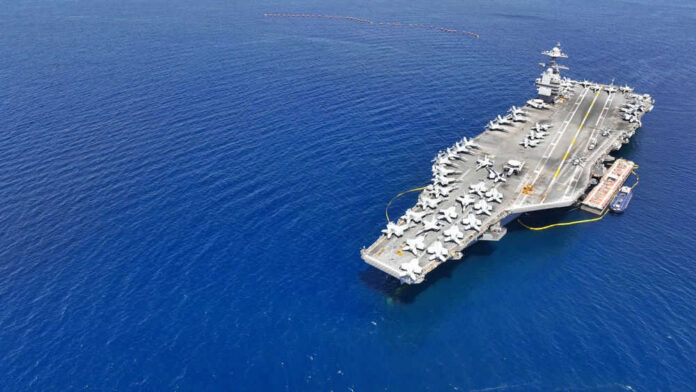
U.S. officials say a third aircraft carrier strike group is heading to the Middle East along with an estimated 9,000 to 10,000 sailors and Marines, bringing the largest American naval presence near Iran in years. The move adds air power, missile defense, electronic warfare, and logistics depth in days, not weeks. The scale alone changes how Tehran, its proxies, and regional partners must plan. More U.S. decks mean more flight sorties, longer on-station time, and a faster trigger if ordered.
The Pentagon calls the buildup a precaution driven by rising threats across the theater. That framing fits a common U.S. playbook with Iran: surge forces to buy time, calm allies, and warn off attacks. It also lines up with reports that President Trump is weighing new strikes, which this posture would make easier and safer for U.S. crews if he decides to act. Deterrence requires visible tools. Three carriers are hard to miss and even harder to ignore.
What Three Carriers Actually Do On Day One
Carrier strike groups bring layered power. Fighters can patrol oil lanes and hit time-sensitive targets. Aegis destroyers can track and shoot down drones and missiles. Electronic warfare jets can blind hostile radars long enough to open a corridor. Amphibious ships add Marines who can secure key terrain, reinforce embassies, and board suspect vessels. Together, these packages let the United States protect shipping, strike terrorist cells, and pressure Iran’s networks, all while keeping options open.
Capacity matters as much as capability. One carrier can surge for a short burst. Two can sustain pressure. Three can cover more axes at once, which complicates Iran’s defense and spreads out risk to U.S. forces. That scale also reassures partners who live under daily missile and drone threat. In plain terms, more decks mean fewer blind spots, faster response, and stronger air defense umbrellas over key routes like the Strait of Hormuz.
The Deterrence Debate: Signal Or Setup?
Analysts have long argued over whether carriers alone deter Iran. Research from the Washington Institute says the record is mixed; ships send a strong signal but do not, by themselves, stop Tehran’s playbook of proxies, deniable strikes, and pressure tactics. The decisive factor has often been the mix of military posture with a live diplomatic channel. When talks exist and pressure is real, escalation tends to pause. When talks stall and force builds, options tilt toward action.
This surge expands decision space for President Trump, which is the point of deterrence done right. It also shortens the fuse if Iran misreads the signal. American conservative thinking favors peace through strength: speak clearly, show reach, and back words with credible force. On that score, three carriers and thousands of troops say the United States will protect its people, ships, and interests, and will not let Iran set the pace or the rules.
How This Could Play Out In The Next Few Weeks
Several paths sit in view. The first is quiet deterrence. Iran tests less, proxies lie low, and shipping flows while backchannel talks restart. The second is limited strikes. The United States could hit a small set of launch sites, drone depots, or training nodes if red lines are crossed, then pause and message for restraint. The third is a rolling contest at sea and in the air, with periodic flare-ups but no march to a wider war. Force posture supports all three.
The United States is undertaking a military buildup of rare scale in the Middle East. Approximately 9,000 to 10,000 U.S. military personnel are deploying to the region alongside a carrier strike group that includes a third aircraft carrier. Meanwhile, Israeli media have revealed… https://t.co/5fQGhJyfiq
— THE WORLD CORRESPONDENT (@TheWorldCorresp) October 5, 2026
The next tell will be where the carriers park and how often aircraft cycle combat air patrols. Frequent patrols, tight convoy escorts, and visible missile defense drills would point to a deterrence-first stance. Dispersed staging, tanker prepositioning, and electronic warfare mapping flights would hint at strike prep. Either way, the region will feel the weight. History says massed U.S. power can cool a hot front line fast, but only smart diplomacy can keep it cool.
Sources:
ksat.com, english.aawsat.com, latimes.com, columbiamissourian.com, sana.sy, aljazeera.com, nypost.com, euronews.com, gcaptain.com, thenationalnews.com