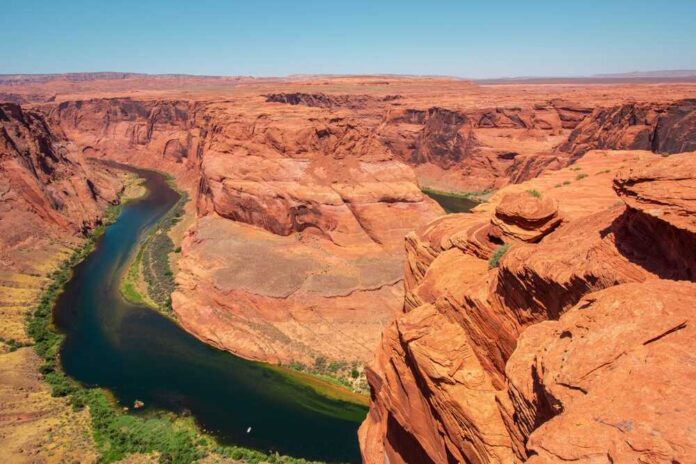
Lake Powell is now hanging just a few dozen vertical feet above the point where Glen Canyon Dam starts to go dark, and that gap is closing fast.
Story Snapshot
- Lake Powell sits only about 34–36 feet above the cutoff for hydropower generation.
- The reservoir is roughly 23% full after a two-decade megadrought hammered the Colorado River.
- Federal managers are cutting releases and juggling emergency plans to avoid hitting “dead power pool.”
- Advocacy groups and media push a crisis story while quiet federal forecasts paint a stark but more measured picture.
How Close Lake Powell Is To Losing Power
Lake Powell’s water surface now hovers near 3,524 feet above sea level, according to official Bureau of Reclamation tracking and independent water-level tools. Minimum power pool for Glen Canyon Dam is about 3,490 feet, the point where the turbines can no longer spin and hydropower stops.
That leaves only a mid-30-foot margin between today’s level and a hard mechanical limit. Some daily updates frame this as “35 feet from losing all power,” and that is not hype; it is simple math.
Lake Powell, the second-largest reservoir in the U.S. located in Arizona and Utah, is nearing critically low water elevation levels, the latest data shows.
Read more: https://t.co/tYDgXZ8PgR pic.twitter.com/qkqLYovE1l
— ABC News (@ABC) July 14, 2026
Public talk often confuses three different lines. The full pool elevation for Lake Powell is 3,700 feet. That is the “lake looks normal” number. The minimum power pool is around 3,490 feet, where power ends.
True dead pool sits much lower, near 3,370 feet, where water cannot pass through the dam at all and downstream release essentially ends. Experts quoted by national outlets are focused on that middle line. The danger zone right now is the loss of electricity, not total cutoff of water.
How Fast The Reservoir Has Been Dropping
Lake Powell did not stumble into this cliff overnight. The reservoir has been sliding for more than two decades as the Colorado River’s flows declined.
Researchers with the United States Geological Survey and university partners show that combined storage in Lake Powell and Lake Mead has fallen by about 33.5 million acre-feet since 2000, a drop of roughly 41%.
Local news in Utah reports year-over-year falls of around 36 feet in recent twelve-month periods, confirming a steep, ongoing trend rather than a one-time dip.
Current inflow projections offer little relief. The Colorado Basin River Forecast Center’s May 5 forecast for water year 2026 shows unregulated inflow into Lake Powell at just 3.27 million acre-feet, about 34% of the historical average. That means the river is delivering only about one-third of normal water volume into a system designed for much wetter years.
When the faucet delivers one-third of the water but downstream demands barely budge, the reservoir behaves like a checking account with more withdrawals than deposits. Americans understand this basic budget truth: if outflows exceed inflows, the account heads toward zero.
Emergency Federal Moves To Slow The Fall
Federal managers are not just watching the decline; they are actively reshaping releases. Bureau of Reclamation studies and news releases describe emergency actions to reduce annual releases from Lake Powell from traditional levels near 7.48 million acre-feet down closer to 6 million acre-feet to protect both Glen Canyon Dam and Lake Mead.
One recent outlook even suggested that, under wet spring conditions, Lake Powell could rise 50–90 feet before easing back later in the year. That sort of swing shows how sensitive the reservoir is to snowpack and short-term policy decisions.
These moves reflect a classic instinct: protect the asset that keeps the lights on. Hydropower from Glen Canyon Dam feeds electricity to millions, and losing that cheap, steady power means rate spikes and greater strain on already stressed grids.
Federal planners aim to keep the lake at least 80–100 feet above minimum power pool in their “most probable” scenario for the coming year.
But that scenario assumes cooperation from nature and from the Colorado River Basin states that share this water under a century-old compact. Assumptions can fail; physical dam limits do not.
Who Is Driving The Crisis Narrative
Much of the “nearing dead power pool” language comes not from official Bureau of Reclamation documents, but from advocacy groups and media outlets quoting experts with a strong policy agenda. Glen Canyon Institute leaders, who have long pushed to drain Lake Powell and restore the canyon, are primary voices in many television segments and online explainers.
Their concern about low levels is real, but their endgame is not simply about keeping the lights on and the taps running. That difference matters when weighing how alarmed to be.
Lake Powell reaching critically low elevation levels, nearing 'dead power pool,' experts say
As of Monday, water levels at Lake Powell measured at 3,524.3 feet above sea level, according to the @USBR tracker. https://t.co/SzEBusvdse
Minimum, or "dead," power pool — in which… pic.twitter.com/p9T8qb8mJw
— Water Mark 🚰 (@OtayMark) July 14, 2026
YouTube creators have joined the chorus, some claiming precise countdowns to the dead pool and “unstoppable” deficits without citing a primary source for each number.
These videos often repeat serious facts, such as today’s elevation or the known minimum power pool, but then leap to doom timelines that do not align with federal 24‑month studies.
The smart move for readers is to trust the physical thresholds and official inflow and release data, while treating unsourced disaster clocks as entertainment rather than engineering.
What This Means For The West’s Water Future
The Lake Powell story sits inside a larger crisis. The Colorado River Basin has endured the longest modern drought in the American West, with climate change shrinking snowpack and raising temperatures so more water evaporates and less reaches the reservoirs.
Federal reports show repeated shortage declarations for Arizona and Nevada since 2020, with cuts triggered whenever Lake Mead and Lake Powell cross preset lines. Policy allowed more use than nature could support for decades, and the bill is now due.
Models reviewed in recent scientific work suggest nontrivial chances that both Lake Powell and Lake Mead will fall into an inactive or dead pool under current rules.
That does not guarantee collapse, but it tells us the risk is real. For 40‑plus readers who have seen Washington dodge hard choices before, the pattern is familiar: stretch promises, ignore math, blame the weather. The response is straightforward.
Demand honest numbers, insist on living within the river’s means, and refuse to let either green activists or political spin doctors turn a physical water crisis into a tool for their broader agendas.
Sources:
abcnews.com, usbr.gov, newsweek.com, eros.usgs.gov, lakepowellwaterlevel.com, youtube.com, lakepowell.water-data.com, watereducationcolorado.org, powell.uslakes.info, colorado.edu