
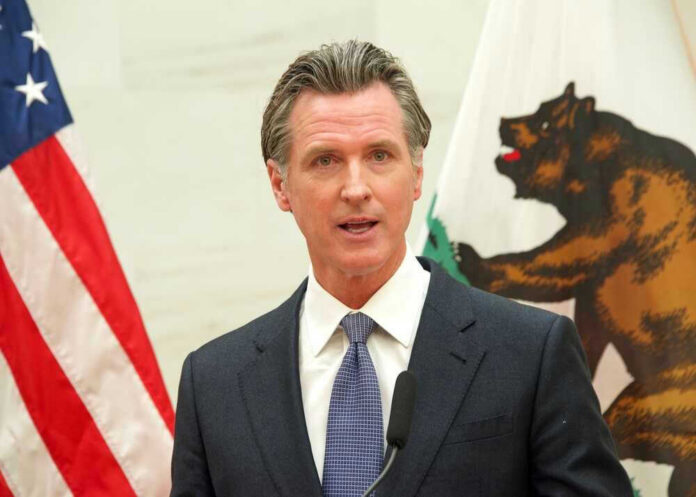
President Trump stood inside the Justice Department and called Gavin Newsom’s decision to spare 548 death row inmates from execution “one of the most shocking acts of injustice our country has ever seen.”
Quick Take
- Trump used a Justice Department event to attack California Governor Gavin Newsom’s clemency decision.
- Newsom converted 548 death sentences to life without parole, calling capital punishment incompatible with California’s values.
- Trump brought victims’ family members on stage and claimed the group included more than 110 child killers and 100 rapist-murderers.
- The clash doubles as early positioning ahead of a possible Newsom run for president in 2028.
Trump Takes His Fight To Federal Law Enforcement’s Front Door
Trump chose the Justice Department as his stage, standing beside Attorney General Todd Blanche to blast Newsom’s clemency order. He told the crowd the commutations represented a betrayal of victims and juries alike. NBC News reported that Trump invited relatives of murder victims to speak, giving his argument a human face beyond political rhetoric.
Trump did not stop at criticism. He claimed the 548 prisoners included more than 110 people who killed children and over 100 who raped and murdered their victims. Those specific numbers came directly from his remarks, but the available reporting has not independently verified them against a full case-by-case record of each conviction.
What Newsom Actually Did, In His Own Words
Newsom’s action did not free anyone. Every one of the 548 inmates moved from a death sentence to life in prison without the possibility of parole, meaning they remain locked up permanently. Newsom framed the move in moral terms, not as a legal technicality. He said state-sanctioned killing undermines the legal system and diminishes everyone connected to it.
Newsom called it a “difficult but righteous action,” arguing the offenders would now “die in obscurity” while victims are “forever remembered and honored.” He also pointed to California’s death penalty system as broken beyond repair, citing wrongful convictions as part of his reasoning for ending executions statewide rather than case by case.
A Fight Over Who Gets The Last Word On Punishment
This is not the first time a governor has emptied death row through mass clemency. Since the modern death penalty returned in 1976, more than 300 capital clemency grants have occurred nationwide, though the pace has slowed sharply compared to earlier decades. Governors in states like Illinois and New Mexico took similar sweeping action before leaving office, often facing comparable backlash.
The deeper question is not whether governors have this power. California’s constitution clearly grants it. The real debate is whether using that power on an entire death row, rather than weighing each case individually, respects the verdicts juries already reached. Trump’s framing treats the commutations as erasing justice. Newsom’s framing treats them as correcting a system he says cannot be trusted to kill fairly.
Politics Hovers Over Every Word
Reuters noted that Newsom is widely seen as a potential 2028 Democratic presidential contender, and described Trump’s Justice Department remarks as an unusually political speech for that setting. That context matters. A sitting president using federal law enforcement as a backdrop to attack a possible future rival blurs the line between justice policy and campaign messaging, even when the underlying facts about the commutations are not in dispute.
Conservatives have every reason to question a decision that reclassifies hundreds of convicted murderers in one stroke, especially when victims’ families say they were blindsided. Common sense says due process cuts both ways. Juries spent years weighing evidence before sentencing these offenders to death.
NOW: President Trump torches California Gov. Gavin Newsom at the Justice Department over his decision to commute the death sentences of 548 inmates.
“You’d have to read their biographies to see how bad they were. Some of them you wouldn’t even believe in all of them, but some of… pic.twitter.com/KdIcrESNpc
— Fox News (@FoxNews) November 23, 2026
A single executive order overriding all of them at once, without a public case-by-case accounting, deserves scrutiny rather than applause. Trump’s demand for that accounting is not an attack on mercy. It is a defense of the process that produced those verdicts in the first place.
What happens next likely runs through California’s courts. Legal challenges questioning whether the state’s highest court must weigh in on mass clemency are already brewing, and the outcome could shape how future governors use this power. Until then, the fight over 548 names will keep colliding with a much bigger argument about who truly answers for violent crime in America.
Sources:
nbcnews.com, newser.com, scribehawk.com