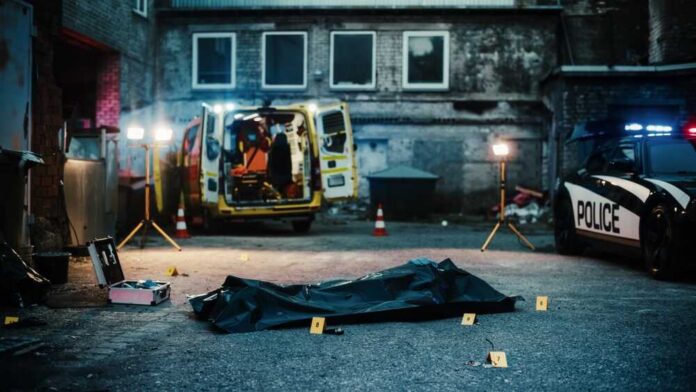
A woman beaten to death in 1936 and secretly buried under a Toronto garage has finally been given back her name, her story, and her place in history.
Story Snapshot
- Demolition workers found a hidden skeleton under a Danforth Avenue garage in 1995.
- For decades, police knew she was murdered but had no idea who she was.
- New DNA and genealogy tools identified her as Scottish immigrant Mary McLeod Moffat.
- Investigators now believe her husband likely killed her around April 1936.
A body under a Toronto garage and a question that would not die
On a spring day in 1995, demolition crews tore up the concrete floor of an old automotive garage at 1515 Danforth Avenue, near Coxwell Avenue in Toronto. Under the slab, buried in the soil like a secret, they found the skeletal remains of a woman in her twenties or early thirties.
Forensic work showed she had suffered at least six blunt force blows to the head from a hammer-like weapon, and that someone had then deliberately buried her under the building. Police understood right away they were looking at a decades-old homicide, but they had no name, no date, and no clear path to justice.
Woman murdered in 1936 and buried underneath building is finally identified: "One of Toronto's oldest mysteries" https://t.co/G1fbB2nQXG
— CBS Mornings (@CBSMornings) July 28, 2026
Investigators tried the usual tools first. They checked missing-person files, coroner records, and old case notes. They studied the bones for clues about age, height, and ancestry. They looked at the building’s history and searched for any trace of a woman who might have vanished in that patch of East Toronto.
Nothing fit well enough to be sure. The case went cold, and “Toronto Jane Doe” became one more silent victim in a city that moved on overhead, never knowing she lay beneath its feet.
How DNA and genealogy reached back ninety years
The story changed in 2022, when the Toronto Police Service decided to bring the case into the world of investigative genetic genealogy. Detectives submitted evidence to Othram, a private forensic DNA laboratory in Texas that specializes in building detailed DNA profiles from old, degraded samples.
Their scientists worked to pull as much genetic information as possible from the remains, finally building a strong profile that could be compared against public genealogy databases and family reference samples. That profile did more than show ethnicity. It pointed investigators toward specific family lines and people who might be related to the unknown woman.
Toronto police genealogists then did the slow, careful work that almost never makes headlines. They followed the DNA leads into family trees, checked names against immigration records, and matched possible relatives to real lives.
Using Othram’s KinSNP rapid relationship testing, they compared a potential relative’s DNA to the woman’s profile. The match helped confirm what the paper trail was beginning to say.
The bones under the garage belonged to Mary McLeod Moffat, born Mary Davidson in Aberdeenshire, Scotland, in 1905, who immigrated to Canada with her family in 1913.
The life Mary built and the violent end she never got to tell
Once her name surfaced, a fuller picture of Mary’s life came into focus. She was part of the early twentieth-century wave of British and Scottish migrants who came to Canada looking for work, stability, and a fresh start.
Records and family interviews show she married and had a son, building an ordinary life in Toronto’s east end. That ordinariness matters. It reminds us that murder victims are not myths or plot devices. They are people whose biggest goals might simply be raising a child and paying the rent on time.
The investigation went back into historical documents, city archives, and family testimony to understand how Mary disappeared. The picture that emerges is dark but tragically familiar.
Police and genealogical reports say that evidence from the burial site, combined with historical records and interviews, indicates Mary was likely killed around April 1936.
Investigators now suspect her husband was responsible for the fatal blows and the hidden burial under the garage, after a confrontation that turned deadly.
He went on living under an alias, Andrew Lloyd Moffat also known as Drake Lloyd Cummings, moving between the United States and Vancouver until his death in 1985.
Justice, closure, and what DNA can and cannot do
The husband will never face a jury. He died decades before science caught up to Mary’s bones. That gap is where modern crime stories test our sense of justice. The facts point in a clear moral direction: a woman suffered multiple head blows, was secretly buried, and then erased from official memory while her suspected killer built a new life.
Police are right to call that a homicide and to name the moral wrong, even if a courtroom will never weigh the evidence in full.
But there is also value in healthy skepticism about process. The public does not see the lab reports, the full chain of custody, or the complete genealogy charts behind the police statements. Identity is now strongly grounded in DNA and family matches, yet the timeline and exact circumstances of the murder rely more on records and reconstruction than on modern forensic proof.
That does not make the police narrative false. It does mean we should keep straight the difference between “very likely” and “legally proven beyond a reasonable doubt.” Such clarity protects both victims and the integrity of the justice system.
A wider shift in how cold cases are solved
Mary’s case is not a one-off miracle. It is part of a wider shift in how Canadian police, including Toronto Police Service, approach unsolved murders and unidentified remains.
Investigative genetic genealogy has helped identify victims in other long cold files and even suspects in historic homicides, turning anonymous bodies into named people and unknown killers into specific men who can at least be judged by history.
That wave of cases reflects both a real advance in science and a growing willingness to lean on private labs and public DNA databases to close the gap.
For families, the payoff is simple and powerful. Someone finally calls and says, “We know what happened. We know where she was. We know her name.” For the rest of us, the payoff is deeper than one solved case. It is a reminder that buried wrongs do not always stay buried. Concrete can crack.
Old bones can speak. A mother lost in 1936 can be found in 2026. And a city that once walked over her without knowing can now say her name out loud: Mary McLeod Moffat.
Sources:
cbsnews.com, globalnews.ca, thespec.com, youtube.com, en.wikipedia.org