
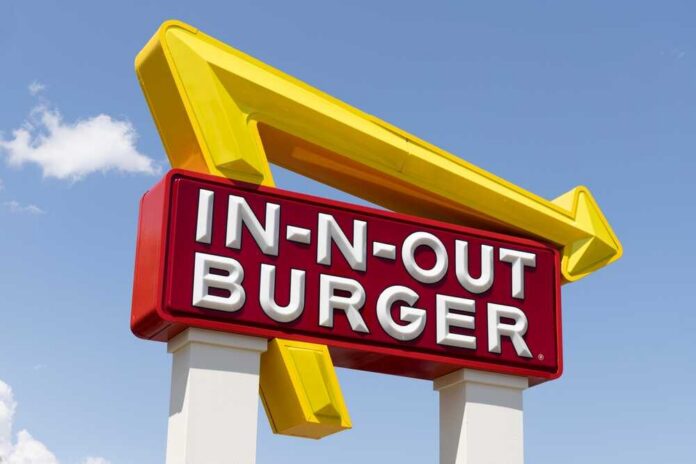
Police say a gunman opened fire at an Idaho In-N-Out, killed three people, and then turned the gun on himself — but the public has seen almost none of the hard evidence behind that story.
Story Snapshot
- Police identified the suspect as 24-year-old Chad Williams and say he died by suicide.
- Three victims were killed and seven injured after the attack at a new In-N-Out in Twin Falls.
- An off-duty trooper and an armed citizen fired back and likely pushed the shooter away from the restaurant.
- Investigators say Williams acted alone, but they have not yet released autopsy or scene records.
The attack that turned a drive-thru into a war zone
On a normal weekend afternoon in Twin Falls, Idaho, a busy In-N-Out Burger became a live shooting scene in seconds. Police say 24-year-old Chad Williams came onto the property and opened fire, hitting people in and around the restaurant. City officials later confirmed that three victims were killed and seven others were injured.
Some injured victims went home from the hospital the same day, while others remained in stable or critical condition. A young, popular spot turned into a place families now connect with fear.
Twin Falls Police Chief Matthew Hicks stepped in front of cameras on Sunday and tried to give the shaken community clear answers. He named Williams as the suspect and said officers had confirmed that Williams was dead from a self-inflicted gunshot wound. Hicks told residents, “We believe the threat to the community is over,” and stressed that the shooter was not at large.
The police account of what happened and why the shooting stopped
According to police, Williams did not have the scene completely to himself. An off-duty state trooper happened to be nearby, and an armed citizen was present when the shooting began. Both fired back at Williams, forcing him to change course and move away from the heart of the restaurant.
Hicks publicly credited their actions with driving the suspect from the scene and preventing more deaths. That is exactly the scenario many gun-rights advocates describe when they argue that trained officers and responsible armed citizens can stop evil faster than a phone call.
Authorities have released more details about the 24-year-old suspect in a Twin Falls, Idaho, mass shooting who died by a self-inflicted gunshot wound. https://t.co/Q3VetuwVEv
— ABC10 (@ABC10) August 3, 2026
Investigators say Williams fired both on the restaurant’s property and in a nearby area, including by a visitor center. Police and city officials later said officers found his body in an area near the restaurant. Hicks and other spokesmen have repeated that investigators are “confident” he acted alone in the attack.
They also stressed that despite online rumors naming other supposed suspects, those identities were “absolutely false” and that no second gunman was involved. That pushback shows how fast wrong names and wild claims can spread when people trust unverified posts more than sworn statements.
Suicide by gunshot: what we know and what we do not
Across the coverage, one line repeats again and again: police say the suspect died from a self-inflicted gunshot wound. Associated Press reports, local television segments, and national sites all echo that same phrase.
Hicks told reporters that, based on the information they had at the time, Williams’s fatal injury came from his own weapon. This matches what often happens in mass shootings, when the gunman either kills himself or is killed by police rather than taken alive.
So far, though, the public has not seen the underlying forensic records that would lock that detail down beyond any doubt. No autopsy report, wound-path diagram, or ballistics reconstruction has been released to show precisely where Williams was, what angle the bullet took, and whether any other weapon could have been involved.
That does not mean the police account is wrong; it means the public is being asked to trust a preliminary narrative mainly on the strength of official voices and repeating headlines. For readers who care about both law and truth, trust should be earned through evidence, not just statements.
The lone-actor claim and the missing motive
Hicks and other officials have said they are “confident” Williams acted alone. Coverage notes there was no sign of another gunman at the scene and no evidence that anyone else fired shots. Police also pushed back against social-media speculation tying innocent people or local firefighters to the attack, calling those claims “completely false.”
That kind of clear correction is welcome: when someone smears a bystander without proof, authorities have a duty to shut it down.
#worldnews#news Idaho Fast-Food Restaurant Shooting Suspect Died By Suicide, Police Say https://t.co/eUw2PxGJBl pic.twitter.com/Gw6f7bda10
— Abolarinw Precious (@AbolarinwP16235) August 2, 2026
Even so, investigators have not yet shared a motive. Hicks has openly said police are still reviewing evidence and do not know why Williams targeted that location. That gap matters. Without motive, the public cannot tell whether this was personal rage, some twisted ideology, or untreated mental illness that exploded in violence.
People want to know whether warning signs were missed, systems failed, or whether evil simply broke through every barrier in silence.
Why first narratives stick and why records still matter
This case shows how quickly an early police story can harden into the “official version” for millions of people. The Associated Press language about a self-inflicted gunshot spread across national outlets and local feeds in hours.
Video clips on social platforms boiled the event down to “suspect died by suicide” and “acted alone,” with few viewers ever hearing the important caveat that the investigation was still ongoing and motive unknown. Fast, simple lines beat slow, detailed records in modern media.
That speed cuts both ways. On one hand, a clear, confident statement from police helps reassure a tense community that the shooter is not coming back. On the other hand, when reporters rely almost entirely on those briefings, they tend to stop asking deeper questions.
They rarely press for autopsy findings, 911 audio, or sworn statements from the off-duty trooper and armed citizen who helped end the attack. A culture that respects law enforcement should also respect transparency. Supporting the police and asking to see the evidence are not opposites; they are two sides of real accountability.
Sources:
apnews.com, youtube.com, ctvnews.ca, wtop.com