

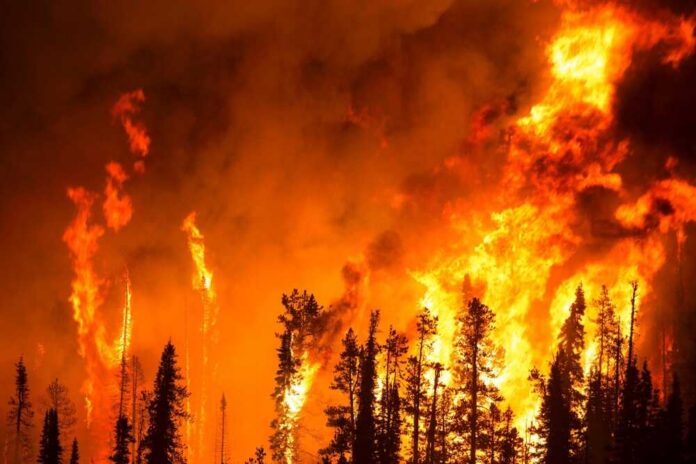
When a fire turns a wine capital into a ghost town and sends families fleeing by boat, you know Europe’s crisis is no longer abstract—it is personal, painful, and a warning shot for the rest of us.
Story Snapshot
- More than 200,000 people evacuated across France and Spain as wildfires raged near Bordeaux and Madrid
- Tourist towns on France’s Atlantic coast emptied overnight, with some residents escaping across the water
- Spain declared a national emergency and put military units in charge of fighting merged fires near Madrid
- France deployed soldiers and called in European Union aircraft, treating the blaze as the worst in its modern history
Fires that turned vacations into emergency escapes
The scene in southwest France did not look like a climate conference slide. It looked like families in shorts and sandals grabbing kids, pets, and car keys as police knocked on doors.
Massive forest fires tore through the Gironde and Landes regions, forcing about 141,000 people from their homes in those two departments alone, according to France’s interior minister. Many had come for quiet beaches and Bordeaux wine. They left with smoke in their lungs and no idea when they would return.
On the Atlantic coast, authorities ordered more mass evacuations around the Cap Ferret peninsula, a narrow strip of land jutting into the ocean that swells with tourists each summer. Flames cut off roads and moved fast through pine forests and campsites. Some people could not drive out.
They boarded boats and crossed the basin to Arcachon, watching their holiday spot burn from the water. That image—escape by sea from a French beach resort—is the kind of detail that snaps even jaded readers awake.
Wildfires in Spain are completely out of control. More than 300.000 people across Spain and France have been evacuated.
Heroic firefighters are fighting day and night to prevent it from spreading further.
Thank you for your immense service. pic.twitter.com/EmH4t5JHq8
— France Safety Travel (@francesafetytra) July 26, 2026
A wildfire that marched toward a major city
The fire did not stay a distant rural problem. Officials said the blaze shifted direction and began advancing toward Bordeaux, a city known worldwide for wine, not disaster.
The mayor warned the flames were within roughly fifteen kilometers of the city’s entry points, close enough to raise real worry about suburban evacuations and urban smoke. Emergency teams spoke of “monster” fire behavior and fire “whirlwinds,” signs of a blaze so intense it seemed to make its own weather.
French leaders treated it as the worst wildfire event the country had seen. President Emmanuel Macron activated a government crisis unit and ordered the armed forces to reinforce exhausted firefighters. Soldiers joined more than a thousand firefighters on the lines.
France requested help from the European Union Civil Protection Mechanism, drawing in Croatian water-bombers, Portuguese Air Tractor planes, and Black Hawk helicopters from Central Europe. This was not a local brush fire. It was a multi-country operation to save lives and keep a major city from choking on ash.
Spain’s national emergency near Madrid
While France battled flames near Bordeaux, Spain faced its own crisis around Madrid and the nearby province of Ávila. The Spanish interior minister declared a national state of emergency focused on wildfires, putting the central government and security forces in charge of response instead of regional officials.
Fires merged near Madrid, and authorities evacuated or confined roughly 60,000 people in affected areas, including tens of thousands told to leave towns west of the capital.
Spain’s Military Emergency Unit, a dedicated military disaster brigade, deployed soldiers to support regional crews, backed by Italy and Greece sending Canadair firefighting aircraft. Prime Minister Pedro Sánchez visited a command post and posted a video pledging shelter and aid for evacuees and those stuck in smoke-choked towns.
From a common-sense view, this shows the core job of government in a crisis: protect lives first, then argue policy later. When fires are at the city edge, nobody cares about talking points—they care about whether the water drops are on target.
Why the numbers keep moving and what they really mean
If you scan headlines, the evacuation totals jump around: 166,000, 200,000, 250,000, even more than 300,000 people forced to flee across France and Spain. That can make anyone suspicious. But this is how fast-moving disasters work. Officials count who left, who returned, and who moved again as different fire fronts flare up.
Media outlets report snapshots at different hours. What matters structurally is not whether the final total is 220,000 or 260,000. The pattern is clear: this was mass displacement on a historic scale.
One Spanish fire commander said the blaze near Madrid now threatened to advance “beyond current extinguishing capacity.” French officials spoke of record acres burned this year, with nearly 98,000 hectares scorched.
Those phrases are not crafted for drama; they are warnings from people whose job is to stay calm. When seasoned firefighters admit a fire may outrun them, regular citizens should appreciate how thin the margin of safety has become in modern European summers.
Common sense questions for the next crisis
These fires raise hard questions that go beyond climate slogans. Local authorities allowed heavy development in pine forests and tourist strips, then watched roads jam as everyone tried to leave at once. European leaders leaned on foreign aircraft and troops because their own fleets were too small for the scale of the burn.
The lesson is simple: states must harden forests, manage fuel, and build serious firefighting capacity before the flames arrive, not after.
🚨 BREAKING: 360,000+ evacuated as wildfires rage across France and Spain. 42,000 ha burned in Gironde alone – worst since WWII. Flames advancing toward Bordeaux wine region. Spain declares national emergency. $WEATHER $EURO #Wildfires #ClimateEmergency
— GlobalFlash (@GlobalFlash_Cam) July 27, 2026
At the human level, hundreds of firefighters were injured and yet kept working long shifts. Families slept in exhibition halls and sports centers turned into shelters. Wine estates watched decades of work sit under a smoke haze.
Despite the chaos, there were no confirmed civilian deaths in the initial wave, a sign that evacuation orders, door-to-door police work, and even boat rescues did their most basic job. Behind all the statistics are people who grabbed their children, locked their doors, and hoped their homes would still be standing when the fire season finally ended.
Sources:
youtube.com, wsj.com, abcnews.com, straitstimes.com, bbc.com, nytimes.com, barrons.com