
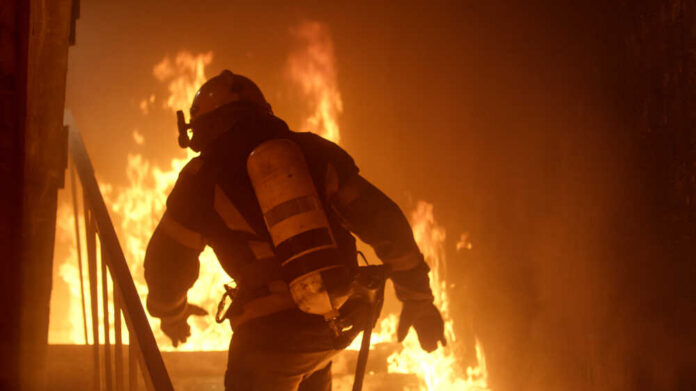
The fourth firefighter to die from Colorado’s June burnover was a 43‑year‑old husband, father, and helitack professional who ran toward a fast‑moving wall of fire when nearly everyone else would have run the other way.
Story Snapshot
- A fast-moving wildfire burnover on June 27 near the Colorado–Utah border killed three firefighters at the scene.
- Helitack firefighter Nathan Matthews survived the initial inferno but died weeks later from severe burn injuries.
- The fire, known as the Knowles Fire and part of the larger Snyder Fire, exposed gaps in wildland safety and support.
- His death marks the fourth firefighter lost in the incident and deepens questions about risk, policy, and priorities.
A lethal burnover on Colorado’s Western Slope
On June 27, a wildfire on Colorado’s Western Slope turned from dangerous to deadly in minutes when a crew of five wildland firefighters was overtaken by flames near the Colorado–Utah line. They were attacking the Knowles Fire, which later folded into a larger complex many reports now call the Snyder Fire.
The crew was part of a helicopter attack team dropped into remote terrain to stop the blaze before it grew out of control. Instead, the fire spread fast and closed off every escape route.
Fire experts call that moment a burnover, when the fire’s speed, wind shift, and fuel all line up against the people in its path. In this case, flames and heat overwhelmed the crew before they could move to safety or reach a burn shelter.
Three firefighters — Emily Barker, Nick Hutcherson, and Sydney Watson — died at the scene. Nathan Matthews and one other firefighter were airlifted out with critical burns, beginning a long fight for life in a burn center far from the mountain slope where everything went wrong.
Who Nathan Matthews was and why he went
Federal officials say Nathan Matthews was 43 and from Lincoln, Nebraska, and part of a wildland fire helicopter attack crew. That job is not a side gig or a summer thrill.
Helitack firefighters train for years to work in steep terrain, jump into remote fires, and make quick decisions under pressure. People like Matthews know the risk.
They go anyway, because someone has to stand between growing fires and the ranches, towns, and highways in their path. That choice is both noble and, in today’s politics, often taken for granted.
Wildland crews work under federal agencies that answer to Washington, but the fires they fight hit local communities first.
Many look at people like Matthews and see exactly the kind of quiet service America should honor and support: citizens doing hard, dangerous work, not for fame, but to protect lives and property.
When we talk about public spending, climate policy, or land rules, this is the human face. These crews are on the line when paperwork, delays, and mixed priorities show up as extra fuel and slow response on the ground.
His fight for life and the official cause of death
After the burnover, Matthews received intensive medical care for severe burns for nearly a month. The United States Department of the Interior later announced he died on a Friday from injuries sustained while battling the Knowles Fire on June 27, and that the incident remains under investigation.
The United States Wildland Fire Service echoed that he died from burn injuries suffered during the incident and had been in treatment since the day of the fire. Multiple news outlets, from national papers to local television, reported the same basic facts.
There is no competing public story claiming some other cause of death, no leaked coroner report pointing in another direction, and no family statement that challenges the agency line. In a media age that often spins doubt from thin air, this matters.
The strongest evidence we have says Matthews died because the burns from that fire were too severe for modern medicine to heal.
Any future questions will likely focus not on the cause itself, but on how he and his crew wound up in such a deadly trap and whether different planning or support might have changed the odds.
Risk, responsibility, and what comes next
Matthews’ death makes him the fourth firefighter killed from that single burnover and adds to at least one other firefighting death in Colorado this year, a helicopter crash that claimed pilot Nicholas Dale.
These numbers are small compared to the national death toll from violent crime or drug overdoses, but they speak to something deeper about how the country treats those who run toward danger. Wildland fire seasons are longer, fuels are thicker, and many rural communities feel forgotten while federal rules pile up.
We are heartbroken by the loss of wildland firefighter Nathan Matthews, who passed away from injuries sustained while responding to the Knowles Fire in Colorado.
Today, we honor his service and remember Emily Barker, Nick Hutcherson, and Sydney Watson, who were also lost during… pic.twitter.com/pRiSjhVfPT
— Bridger Aerospace (@BridgerAero) July 26, 2026
When a helitack firefighter dies from burn injuries weeks after a known incident, any serious review should look hard at training, gear, and command decisions. But it should also look at big-picture policy.
Honoring Matthews means more than flying flags at half-staff. It means making sure risk on the line is driven by nature, not by red tape, delay, or politics that treat these firefighters as numbers instead of neighbors.
Sources:
cbsnews.com, fox13seattle.com, facebook.com, usatoday.com