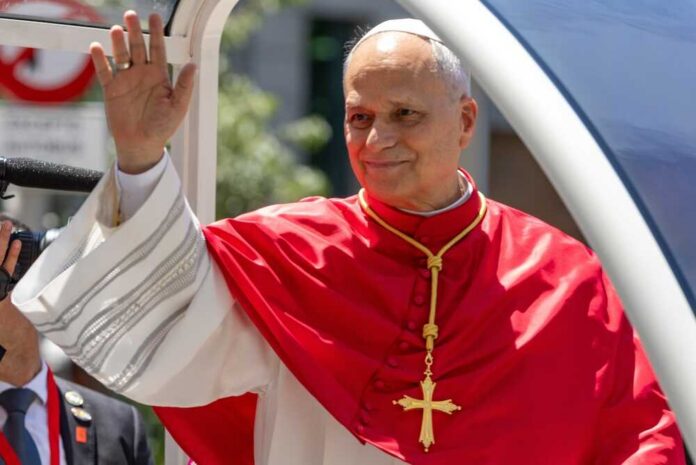
The first American pope chose a migrant island on Independence Day to tell the United States its greatness hangs on how it treats strangers at the gate.
Story Snapshot
- Pope Leo tied welcoming immigrants to core Catholic pro-life teaching and human dignity.
- He delivered his July 4 appeal from Lampedusa, a frontline island for desperate migrant crossings.
- His message clashes with President Trump’s hardline laws, orders, and funding for enforcement.
- The deeper fight is over what “pro-life” and national strength really mean in American politics.
A July 4 homily from the edge of survival
Pope Leo did not speak from the National Mall or a marble hall in Washington. He chose Lampedusa, the Italian island where overloaded boats arrive and where some never make it to shore.
On America’s 250th birthday, he told the United States to “welcome, protect, and defend immigrants” as part of a culture that defends life from conception to natural death. This was not a travel sermon. It was a moral warning delivered where the stakes are measured in bodies, not in polls.
Pope Leo marked the 250th anniversary of U.S. independence on Saturday with an appeal to Americans to welcome and protect immigrants. MORE: https://t.co/XXrK11KyP4 pic.twitter.com/CDNkj89xVJ
— NEWSMAX (@NEWSMAX) July 4, 2026
The pope framed the call as about who people are, not what they cost. In his anniversary letter to the United States, he said welcoming immigrants means recognizing their built-in dignity, not just offering charity when it feels convenient.
He pointed to America’s own story: waves of newcomers who built its factories, fought its wars, and shaped its culture. His question, left hanging in the air, was simple: can a nation born of immigrants forget the very path that formed it?
Pope Leo’s pro-life test for Catholic politics
Leo’s appeal cut straight at a growing split in American conservatism: many politicians call themselves “pro-life” on abortion, then back harsh deportations and family separations. At Castel Gandolfo, he had already said that “inhuman treatment of immigrants in the United States” cannot be squared with a pro-life identity.
Catholic teaching, he reminded listeners, links life and dignity from the unborn child to the undocumented father in a detention center. That unity breaks when policy defends one and discards the other.
The pope is not a border abolitionist. He has said clearly that every country has the right to decide who enters and how. But he insists that enforcement must respect human dignity, avoid treating immigration status as a crime by itself, and keep families together whenever possible.
For many American Catholics, especially older ones, this hits close to home. Their grandparents once crossed oceans. Now they must decide if their vote backs policies that would have turned those same grandparents away.
Trump’s hardline system and the collision course
Leo’s July 4 message did not land in a vacuum. President Trump’s second administration has built a dense wall of law, money, and rules aimed at cutting immigration sharply. Congress passed the Secure America Act, sending almost seventy billion dollars to enforcement through 2029.
Trump signed the Laken Riley Act, which forces detention of many immigrants who are arrested or charged with certain crimes. A new executive order even froze refugee admissions for ninety days, claiming they harmed the United States.
Agencies followed that lead. United States Citizenship and Immigration Services announced that many immigrants must now adjust status outside the country, making green cards far harder to secure from within. The State Department canceled tens of thousands of visas and paused processing from dozens of countries.
None of those moves answer Leo’s call to “welcome, protect, and defend”; they signal a government focused on control first, prudence and mercy second. From a common-sense view, they reflect a belief that chaos at the border threatens order at home, even at the cost of individual hardship.
Where Catholic teaching meets American sovereignty
This clash exposes a deeper tension inside Catholic circles and broader conservative thought. Catholic social teaching says states have a duty to respect the right to migrate and to receive those who come, while also keeping order and the common good.
John Paul II once urged the United States to defend against unjust limits on a person’s right to move, even across borders. Pope Francis and now Leo have repeated that theme, arguing that rich nations cannot close their doors and still claim to honor human dignity.
Some conservative Catholics push back, warning that loose borders can erode sovereignty, strain public services, and weaken the rule of law. Leo answers by pointing to the bishops’ own message, which says charity never stands against order, and policy must honor both the immigrant’s dignity and the nation’s right to protect itself.
That balance is the hard work. His Lampedusa homily did not offer a bill text or a budget score. It did something sharper: it told American Catholics their conscience cannot be split by party talking points.
What this means for readers who vote, pray, and worry
Pope Leo’s July 4 appeal forces a personal audit for any American who cares about life, faith, and security. Trump’s policies answer fear of crime, strain, and disorder with firm rules and big spending, but they lack public, detailed evidence that harsh measures are the only way to keep people safe.
Leo’s words answer with stories of suffering and a call to mercy, yet they skip hard numbers on costs and do not spell out border tactics in detail. Both sides leave some facts on the table.
For a voter over forty, this is not a theoretical debate. It shapes what kind of country your grandchildren inherit. Leo is not asking you to choose open borders.
He is asking whether your idea of “pro-life” and “pro-American” includes the desperate mother on a raft as well as the child in the womb. The uncomfortable truth is that a healthy nation must wrestle with both, not play them against each other for one more election cycle.
Sources:
cnbc.com, vaticannews.va, vatican.va, reuters.com, cnn.com, facebook.com, youtube.com, aclu.org, nafsa.org, whitehouse.gov, brookings.edu, justiceforimmigrants.org, avemarialaw.edu