
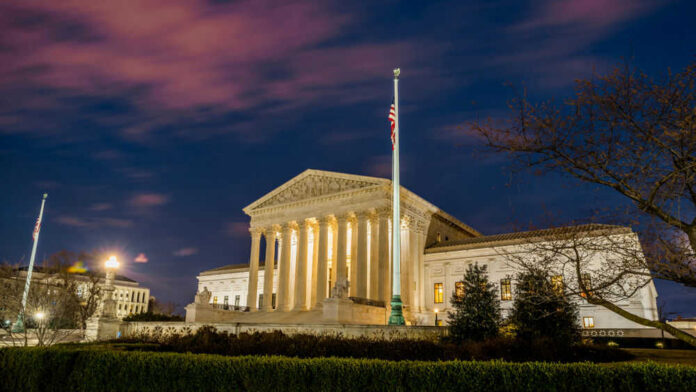
The Supreme Court’s quiet refusal to touch President Donald Trump’s appeal may tell you more about power, proof, and speech in America than any shouting match on cable news.
Story Snapshot
- A federal jury found Trump sexually abused and defamed E. Jean Carroll, awarding $5 million in damages.
- Two higher courts reviewed that result; both left the core findings fully intact.
- The Supreme Court then declined to even hear Trump’s appeal, ending his legal road on this case.
- The fight now shifts from courtrooms to public opinion, media framing, and free speech debates.
How a 1996 dressing room encounter became a Supreme Court dead end
E. Jean Carroll says she met Donald Trump at Bergdorf Goodman in Manhattan in the mid 1990s, and a flirtatious moment turned into a violent sexual assault in a dressing room.
She did not go to police at the time and there is no physical evidence from that night, which many Americans find troubling when they hear about the case. Years later, she went public and Trump responded by calling her story a hoax and denying it in blunt, often mocking language.[1][6]
Carroll then used civil law, not criminal law, to seek accountability. A New York jury heard her detailed account of Trump pinning her against a wall, kissing her without consent, and forcibly penetrating her with his fingers.
That jury did not find rape under New York’s narrow criminal definition. But it did find Trump liable for sexual abuse and for defamation based on his 2022 Truth Social post attacking Carroll’s claims, and it awarded her $5 million in total damages.[1][3]
What the lower courts said about evidence and Trump’s arguments
Trump’s lawyers argued the trial was unfair. They objected to the jury hearing from two other women who described past sexual assaults by Trump, and they opposed the use of the 2005 Access Hollywood recording where Trump bragged about grabbing women.
The trial judge allowed this material under federal rules that let juries see patterns of sexual misconduct when a plaintiff claims sexual assault. The judge later wrote that Carroll’s rape accusation was “substantially true” under the everyday meaning of the word.[5][6]
Trump appealed to the United States Court of Appeals for the Second Circuit. That court looked closely at the trial judge’s choices and backed him. It said the other women’s testimony and the recording fit the rules that permit evidence of other sexual assaults and did not violate Trump’s rights.
It also upheld the $5 million award. In simple terms, the appeals court told Trump: the process was fair enough, the jury’s decision stands, and there is no need for a new trial or a lower damages number.[6]
President Donald Trump said he will continue fighting what he called a fake case after the Supreme Court declined to hear his appeal of a $5 million civil judgment in favor of writer E. Jean Carroll. https://t.co/rQYRblYY1y
— NEWSMAX (@NEWSMAX) June 29, 2026
Why the Supreme Court walked away and what that means
After losing in the appeals court, Trump took his arguments to the United States Supreme Court. He wanted the justices to say the trial judge crossed the line with inflammatory evidence and political framing.
On June 29, 2026, the Supreme Court declined to hear his case, offering no explanation, which is standard when it refuses review. That single move made the $5 million verdict final. Trump now must pay Carroll, and the official record says he sexually abused and defamed her.[2][4]
The Court’s refusal does not mean all nine justices agreed with every choice the trial judge made. It means at least four justices did not think the case raised a big enough legal question for the Court to step in.
Sex, speech, and “actual malice” in the age of public figures
The Carroll case also shows how defamation law now sits at the center of fights over sexual misconduct. Carroll could not bring a timely criminal case, so she went after Trump’s words.
Because Trump is a public figure, she had to prove he spoke with “actual malice,” meaning he knew what he said was false or acted with reckless disregard for the truth. The jury agreed she met that high bar when it looked at his 2022 denial of her claims.[3][16][17]
That standard protects rough debate about public figures but also makes it hard for victims to fight back when powerful people call them liars. Some worry defamation cases can chill free speech and political talk.
Others argue that when a leader publicly smears a private person who alleges serious abuse, courts should demand honesty and care. The Carroll verdict and the Supreme Court’s silence push those tensions into the open, where voters, not judges, will sort them out.
Sources:
[1] Web – Supreme Court rejects Trump’s push to toss $5 million verdict in E. …
[2] Web – Jury finds Trump liable for sexual abuse, awards accuser $5M
[3] Web – Supreme Court Lets $5 Million Sex Abuse Verdict Against Trump …
[4] Web – E. Jean Carroll v. Donald J. Trump – Wikipedia
[5] Web – Judge clarifies: Yes, Trump was found to have raped E. Jean Carroll
[6] Web – CARROLL v. TRUMP (2023) – FindLaw Caselaw
[16] Web – Public Officials in Defamation Legal Claims – Justia
[17] Web – Defamation of a Public Figure vs. Private Figure