
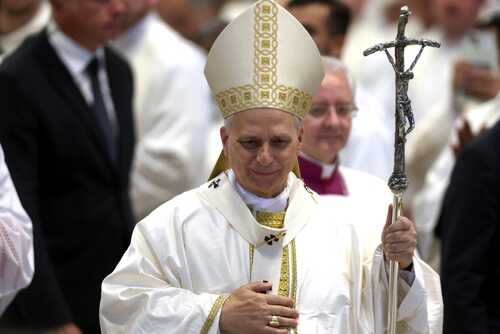
Pope Leo XIV just escalated his public pressure campaign over the Iran war—directly calling out the leaders driving the conflict and demanding an immediate ceasefire.
Quick Take
- Pope Leo XIV issued his strongest appeal yet, directly addressing “those responsible” for the war and calling for a ceasefire and renewed dialogue.
- The conflict has continued for roughly two weeks, with major escalation beginning February 28, 2026, and no ceasefire currently in place.
- Reports describe heavy civilian suffering, including large-scale displacement in Lebanon and continued strikes in Iran and Lebanon.
- Regional instability is spreading, with multiple countries reporting interceptions of drones or missiles and a U.S. embassy warning Americans to leave Iraq.
Pope Leo XIV’s Message Shifts From General Appeals to Direct Accountability
Pope Leo XIV used his Sunday address to deliver what multiple outlets describe as his most direct intervention since the conflict began, shifting from general concern to a pointed appeal aimed at the leaders driving the fighting.
His call—“Cease the fire! Let paths of dialogue be reopened!”—was framed as a moral plea on behalf of Christians and “people of goodwill.” The step-up in tone matters because it signals rising urgency from a major global religious figure.
Pope escalates call for ceasefire in Iran by addressing those responsible for the war https://t.co/u73m0bQmbi
— ABC13 Houston (@abc13houston) March 15, 2026
The Pope also singled out Lebanon for attention, voicing hope that dialogue could support “lasting solutions” as violence spreads across borders.
The reporting available does not indicate any immediate diplomatic breakthrough tied to his statement, and the war continues. Still, the Pope’s choice to address responsibility—rather than merely tragedy—adds a new layer of international pressure at a moment when civilians are absorbing much of the cost.
A Fast-Moving Conflict With Competing Claims and Expanding Fronts
Reports trace the current cycle of fighting to February 28, 2026, when the first major escalation began. One widely cited early incident is a strike on a girls’ elementary school in Minab, Iran, with casualty figures reported by Iranian media but not independently verified.
As the fighting intensified, Hezbollah began firing rockets toward northern Israel in support of Iran, widening the conflict beyond a single front.
Israel has said some strikes target areas where Hezbollah stores weapons, while the overall battlefield picture described in the research includes strikes across Iran and Lebanon and repeated air-defense activity in the region.
Saudi Arabia reportedly intercepted drones over Riyadh and the Eastern Region, and other Gulf states reported air-defense interceptions as well. The available sources do not provide independent, comprehensive verification for every claim, underlining the fog of war.
Civilian Toll and Humanitarian Stress Drive International Alarm
The humanitarian impact described in the reporting is severe. In Lebanon, figures cited in the research say more than 800,000 people have been displaced from their homes, a destabilizing number for any country—especially one already strained by past crises.
The sources also describe attacks affecting healthcare capacity, a pressure point that tends to ripple outward into higher mortality and prolonged suffering long after the fighting stops.
One especially alarming development was the reported killing of twelve medical workers when a strike hit a health center in southern Lebanon. The World Health Organization condemned that strike as “unacceptable,” reflecting broader concern that civilian infrastructure is being pulled into the conflict’s gravitational field.
Separately, strikes on an industrial zone in Isfahan reportedly killed at least 15 people, adding to fears that the war is broadening in scope and consequence.
Security Spillover: Embassy Warning and Regional Interceptions Signal Risk of Wider War
Security warnings are also escalating. The U.S. embassy in Baghdad issued a warning for American citizens to leave Iraq after a missile struck the embassy compound. This development highlights how quickly this conflict can threaten Americans and U.S. interests beyond the immediate battle zones.
Regional air-defense activity and reports of interceptions in multiple countries further reinforce that the conflict is not confined to a single narrow corridor.
From a U.S. perspective under President Trump, the immediate policy challenge is balancing national security objectives with a clear-eyed assessment of escalation risk and humanitarian fallout.
The Pope’s appeal does not change battlefield realities on its own, but it amplifies the global demand for a ceasefire and negotiations. With casualty estimates in Iran described as unverified in parts of the reporting, the need for reliable information remains urgent.
No ceasefire has been established as of the latest updates described in the research, and the cycle of strikes, interceptions, and displacement continues.
For Americans frustrated by years of foreign-policy drift and vague objectives, this moment underscores the importance of defined goals, truthful accounting of costs, and strict constitutional clarity about the scope and authorization of U.S. military commitments. The Pope’s message is ultimately a reminder: wars expand fast, and innocent people pay first.