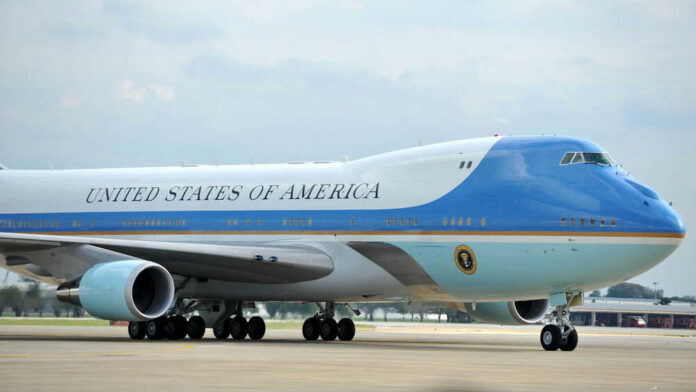
A foreign-gift jet is now flying as “Air Force One,” and the media’s spin threatens to overshadow what the Air Force says is a practical bridge to keep the commander in chief moving.
Story Highlights
- The Air Force says the ex-Qatar Boeing 747 will serve as a temporary bridge Air Force One until Boeing delivers two new aircraft in 2028 [3].
- Trump unveiled the refurbished jet at Joint Base Andrews; officials say modifications and testing are complete for presidential transport [1][3].
- Cost estimates vary widely, from “hundreds of millions” to over $1 billion, leaving fiscal claims contested [1][2][7].
- Ethics critics cite the plane’s foreign-gift origin; the Pentagon says it lawfully accepted and modified the aircraft for U.S. use [1][3].
Air Force Positions The Jet As A Temporary Bridge For Mission Continuity
Air Force leaders described the former Qatari Boeing 747 as a bridge aircraft to cover the presidential airlift mission until two new Boeing replacements arrive in 2028. They said modifications and testing are complete and the jet can support presidential travel this summer.
This plan keeps the mission going while the aging VC-25A fleet nears retirement and Boeing works through delays. Officials framed the move as a practical step to maintain secure, reliable lift, not a permanent change [3].
President Trump unveiled a Boeing 747, a gift from Qatar that was overhauled by L3Harris Technologies and is set to join the Air Force One fleet with a custom livery https://t.co/og9LfYHq5y pic.twitter.com/iwXxs9z637
— Reuters (@Reuters) June 20, 2026
President Donald Trump unveiled the aircraft at Joint Base Andrews on June 19, 2026. The aircraft now wears a red, white, and blue livery with the presidential seal and “United States of America” along the fuselage.
The reveal signaled that the Air Force’s interior and systems work reached a stage ready for operations. The administration and the Air Force both referred to it as a completed interim solution while the replacement program advances on its 2028 target [1][2].
What Changed Inside: Communications, Security, And Mission Systems
The Air Force said the Texas modification work added the security, communications, and other features needed for presidential use, including advanced communications tools. Trump also touted the integration of modern connectivity on board.
The goal is enabling command-and-control, crisis response, and secure communications while airborne. That is the core standard that separates an ordinary airliner from a presidential platform. The Air Force’s statements affirm those upgrades are in place for near-term missions [1][4].
Supporters highlight the aircraft’s relatively low flight time and larger size versus the outgoing VC-25As. Trump said the jet logged about 800 flight hours, which suggests modest wear for a wide-body.
Reports also note it is longer and can carry more weight, offering more room for staff, press, medical, and secure communications gear. Those gains can help during long trips and complex itineraries. Still, some performance claims came from remarks, not detailed test data made public yet [1][2].
Cost Questions And Transparency Gaps Fuel Ongoing Debate
Reported costs vary. ABC News said the Pentagon spent hundreds of millions on retrofits, while others estimated the total conversion would not surpass $400 million. Some experts told NBC News costs could exceed $1 billion, especially if advanced systems pushed timelines and budgets.
That spread shows the public does not yet have a firm ledger. Without a released contract and audit data, the “savings” vs. waiting argument will remain unsettled and open to political attack from both sides [1][2][7].
Critics question legality and ethics because the jet began as a foreign gift. Coverage flags concerns about taking an asset valued around $400 million from Qatar, even with executive-branch acceptance.
The Air Force and Pentagon say the aircraft was accepted and modified for U.S. use as a bridge only, which is consistent with their official role. Still, until the government releases the gift instrument, transfer terms, and eventual disposition plan, opponents will claim risk to independence and optics [1][3].
What We Know, What We Do Not, And How To Judge It Fairly
Public reporting confirms the bridge purpose, the official unveiling, and statements that modifications and testing finished. It also confirms the plan to rely on this jet until Boeing delivers in 2028.
But the record we can see does not include final survivability certifications, electromagnetic protection reports, or full communications testing packages. Those are usually classified or tightly held. That gap does not prove shortfalls. It does mean the public is judging a national-security aircraft without the normal proof set [1][3].
The bottom line for readers is this: the Air Force has put a working bridge aircraft in service to protect travel continuity now, while the permanent replacements are finished. That is a mission-first decision many can respect.
At the same time, Congress and watchdogs should press for reasonable transparency on cost, contracting, and legal terms to guard taxpayers and ensure no one exploits the gift optics. Strong oversight and strong capability can and should go together [3].
Sources:
[1] Web – Trump unveils the new Air Force One, a converted Qatari jet
[2] Web – Trump unveils Qatari-donated 747 Air Force One – ABC News
[3] Web – ‘Nothing like it.’ Trump unveils new Air Force One gifted by Qatar
[4] Web – Qatari 747 will be ready to fly as Air Force One this summer – NPR
[7] Web – Boeing VC-25B Bridge – Wikipedia