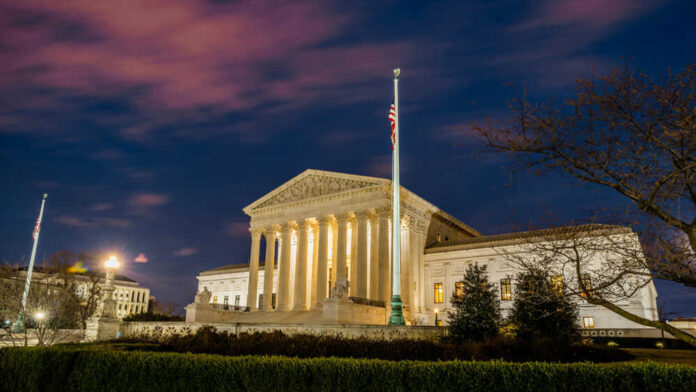
The Supreme Court unanimously reinforced police authority to enter homes without warrants during emergencies, delivering a decisive victory for law enforcement while rejecting dangerous restrictions that could have handcuffed officers from saving lives.
Story Overview
- Supreme Court unanimously upholds Montana police’s warrantless home entry during a suicide emergency response
- Ruling clarifies “objective reasonableness” standard nationwide, rejecting stricter probable cause requirements
- Montana Attorney General hails decision as “huge win for law enforcement,” enabling officer safety actions
- Decision resolves circuit court splits that created inconsistent Fourth Amendment applications across states
Supreme Court Backs Emergency Police Response
On January 14, 2026, the U.S. Supreme Court issued a unanimous decision in Case v. Montana, affirming police officers’ authority to enter homes without warrants when responding to genuine emergencies.
Justice Elena Kagan authored the opinion supporting Anaconda-Deer Lodge police officers who entered William Case’s home in 2021 after his ex-girlfriend reported suicide threats.
The Court applied the established “objective reasonableness” standard from Brigham City v. Stuart, prioritizing life-saving interventions over rigid warrant requirements that could delay critical emergency responses.
🚨BREAKING🚨
The Supreme Court just ruled 9-0 that a warrantless "welfare check," where police shot Trevor Case in his own home, was justified in Case v. Montana.
Apparently, police DO NOT need probable cause to break into gun owners' homes WITHOUT WARRANTS & shoot them. https://t.co/S2KHSx3Mos pic.twitter.com/hWrTWu7UqT— Gun Owners of America (@GunOwners) January 14, 2026
The case originated when officers responded to a 911 call reporting Case had threatened suicide and possibly shot himself. Upon arrival, officers observed an open gun case and blood-like substance, providing objective evidence supporting immediate entry.
Case emerged from a closet armed, assaulted an officer, was wounded, and subsequently convicted. His legal challenge claimed the warrantless entry violated Fourth Amendment protections, but both state and federal courts recognized the emergency aid exception as constitutionally sound.
Constitutional Clarity Against Judicial Overreach
The ruling effectively corrected Montana Supreme Court’s flawed “caretaker doctrine” reasoning while affirming the correct outcome. Montana Attorney General Austin Knudsen praised the decision as eliminating confusion that threatened officer effectiveness, stating it “allows officers to keep communities safe.”
The Court specifically rejected Justice Laurie McKinnon’s dissenting position requiring probable cause, which Knudsen characterized as “extreme.” This correction prevents activist judges from imposing additional barriers that could endanger both officers and citizens during time-sensitive emergencies.
Chief Bill Sather of the Anaconda-Deer Lodge Police Department emphasized the practical benefits, noting the ruling “makes it much easier for officers to do their job.” The decision resolves dangerous inconsistencies where some lower courts had imposed probable cause requirements for emergency aid situations. Such restrictions created a patchwork of conflicting standards that could force officers to hesitate during life-threatening situations, potentially resulting in preventable deaths or injuries while bureaucratic procedures delayed necessary interventions.
Protecting Public Safety From Legal Technicalities
This unanimous decision strengthens the constitutional framework supporting effective law enforcement while maintaining appropriate limits on government power. The Court distinguished emergency aid from routine community caretaking functions, ensuring the exception applies only to genuine emergencies requiring immediate response.
The ruling reinforces that when officers have objectively reasonable grounds to believe someone needs immediate assistance, constitutional protections don’t require waiting for judicial approval that could prove fatal during medical or safety crises.
An appropriate, unanimous decision. "Supreme Court sides with Montana police on warrant requirements during emergencies"https://t.co/lg294h8Jl9
— Rob Douglas (@RobDouglas3) January 14, 2026
The decision provides nationwide consistency in Fourth Amendment applications, preventing liberal jurisdictions from imposing additional restrictions that could compromise public safety.
By affirming the objective reasonableness standard without requiring probable cause for emergency aid, the Court ensures officers can focus on protecting lives rather than navigating complex legal calculations during crisis situations.
This common-sense approach balances constitutional rights with practical realities of emergency response, supporting both effective policing and genuine constitutional protections against unreasonable searches.
Sources:
Court finds police properly entered man’s home despite absence of a warrant
Supreme Court backs warrantless entry in emergencies