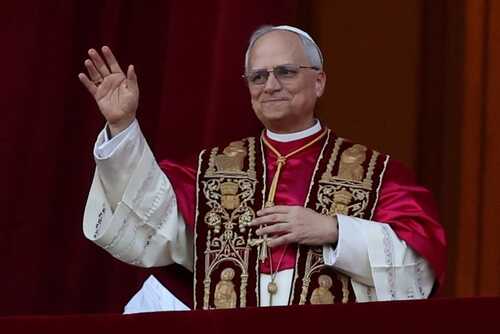
A pope just asked forgiveness for centuries-old slavery decrees that helped build the modern world—and he did it in the name of the very institution that signed them.
Story Snapshot
- The first U.S.-born pope, Leo XIV, used his debut encyclical to apologize for the Vatican’s role in legitimizing slavery.
- He cited 15th‑century papal decrees that authorized European rulers to conquer non‑Christians and reduce them to “perpetual slavery.”[1][3]
- He called the Church’s delay in condemning slavery “a wound in Christian memory” and asked, “in the name of the Church,” for pardon.[1][2][3]
- He tied that history to modern “forms of slavery” in artificial‑intelligence era supply chains.[1][3]
A Pope Reaches Back Five Centuries To Say “We Were Wrong”
Pope Leo XIV did something many Catholics assumed would never happen: he explicitly apologized for the Holy See’s institutional role in legitimizing slavery, and not just for the sins of anonymous “Christians.”[1][2][3]
In his first encyclical, “Magnifica Humanitas,” he acknowledged that past popes issued rulings that empowered European sovereigns to enslave non‑Christians, then admitted the Church took far too long to recognize slavery’s fundamental clash with Christian teaching.[1][3] That is institutional, not symbolic, language.
Pope Leo XIV called the Vatican's role in legitimizing slavery a "wound in Christian memory." https://t.co/ysXh5Y82HM
— ABC7 News (@abc7newsbayarea) May 26, 2026
Leo did not hide behind vague regret. He described the Vatican’s slavery‑stained history as “a wound in Christian memory,” then wrote, “For this, in the name of the Church, I sincerely ask for pardon.”[1][2][3]
That phrase matters. Recent popes condemned slavery and apologized for believers’ actions, but they stopped short of saying the Holy See itself—through papal decrees—helped authorize it.[1][3]
Leo crossed that line. For anyone who values moral clarity over institutional pride, that is a meaningful shift.
The Forgotten Documents That Licensed “Perpetual Slavery”
Leo’s apology did not emerge from a generic sense of guilt; it pointed to specific documents. Media accounts describe him referencing 15th‑century papal bulls, including “Dum Diversas” of 1452, where Pope Nicholas V granted Portugal authority to “invade, conquer, fight and subjugate” non‑Christians and “reduce their persons to perpetual slavery.”[1][3]
Those decrees later undergirded what became known as the Doctrine of Discovery, the legal‑theological logic Europeans used to justify conquest across Africa and the Americas.[1][3]
For decades, critics have argued that these texts were not marginal footnotes but moral dynamite: neat Latin phrases that gave royal courts the blessing they wanted to claim lands and bodies.[3]
The Vatican formally repudiated the Doctrine of Discovery in 2023, but that statement largely sidestepped the blunt reality of “perpetual slavery” language.[3]
Leo’s encyclical, as reported, finally connects the dots: those bulls helped legitimize slavery, and the Church admits it was late—“eighteen centuries” late, he wrote—to grasp and state the full incompatibility between the Gospel and owning human beings.[3]
Why He Linked Slave Ships To Server Farms
On the surface, “Magnifica Humanitas” is about artificial intelligence, not colonial ships.[1][3] Leo used the encyclical to warn that digital technologies and globalized labor can turn people into disposable inputs, stripped of dignity and voice.[1]
He pointed to miners scraping rare minerals for our devices and to workers buried in opaque supply chains as examples of what he called new “forms of slavery and colonialism” tied to the artificial‑intelligence economy.[1][3] That is where his apology becomes more than a history lesson.
The core instinct says: human beings are not cogs, and no system—feudal, colonial, or digital—has the right to treat them as such. Leo’s logic leans on that same moral intuition.
The Church once wrapped spiritual language around the empire’s economic interests; today, political and corporate elites wrap ethical slogans around data extraction and cheap labor. By confessing the first error, he warns believers not to commit the second. From a values standpoint, that is overdue course correction.
Does Saying “Sorry” Centuries Later Actually Matter?
Critics on the right and left are already splitting. Some see a savvy public‑relations move: apologize for long‑dead popes while keeping modern power intact.
Social‑media skeptics call it “performative” and demand reparations, while others grumble that apologizing for ancestors undermines today’s Church. Both miss a key point.
A serious institution that claims to teach moral truth must, at some point, either defend its record or admit where it violated its own standards. Silence is the easy route; Leo chose the harder one.
Those concerns are legitimate. The reporting so far does not show a legal concession of liability, only a moral acknowledgment of error and complicity.[1][3]
But if you believe personal responsibility scales up to institutions, then facing the record honestly is not “woke”; it is what repentance looks like in the public square. Leo just dragged that conversation out of the archives and into the spotlight.
Sources:
[1] Web – Pope Leo XIV makes historic apology for Vatican’s role in legitimizing …
[2] Web – Pope Leo XIV makes historic apology for Vatican’s role in …
[3] Web – Pope Leo XIV apologizes for Catholic Church’s role in …