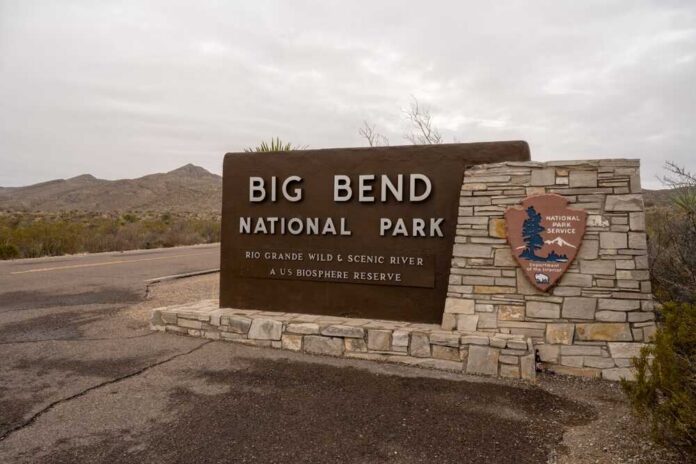
Hours after bulldozers cut into Big Bend, federal leaders hit pause and flew in to see why.
Story Snapshot
- Customs and Border Protection approved over $1.7 billion for Big Bend border infrastructure in 2026.
- Officials said funds cover vehicle barriers, patrol roads, and sensors, not a tall wall through the park.
- Construction inside Big Bend National Park paused after public outcry and local law enforcement pushback.
- Five Big Bend sheriffs argued the terrain already acts as a strong natural barrier.
What Paused, Where, And Why It Matters
Customs and Border Protection awarded one of the largest single task orders tied to the southern border in May 2026, marked “for border wall in Big Bend Texas,” at $1.72 billion to a major contractor.
After crews began clearing ground in and near Big Bend National Park, the agency paused work to review next steps amid strong local backlash and questions about strategy and legality. The pause does not cancel the contract. It signals a reassessment of what to build, and precisely where, across rugged federal lands.
Agency officials told reporters the plan emphasizes low-profile vehicle barriers, patrol roads, and technology, not a 30-foot wall through iconic canyon corridors. That clarification matters because labels on federal awards can lag design changes.
The public sees “border wall” on a database and expects steel bollards. The agency sees a menu: road grading, bollards where vehicles can pass, surveillance masts, and gates that can open during floods or rescues. Both versions can be true on paper, but only one will shape the park’s future.
Local Lawmen And Park Veterans Push Back
Five border-county sheriffs in the Big Bend region issued a joint statement saying the area’s mountains, canyons, desert, and the Rio Grande already form natural barriers that blunt vehicle smuggling and foot traffic.
Terrell County Sheriff Thaddeus Cleveland, a Republican and former Border Patrol agent, said he backs border security but opposes new vehicle barriers placed in stretches where you cannot drive a truck anyway. That argument aligns with common-sense conservatism: spend where the return is real; do not move dirt for headlines.
Retired Big Bend National Park superintendents urged the Department of Homeland Security to avoid sweeping legal waivers and skip heavy construction inside the park, warning of “unnecessary and highly destructive” impacts without public review.
Conservation groups reported bulldozers tearing out native plants near Santa Elena Canyon and said environmental and cultural surveys were skipped after laws were waived. These claims are advocacy, but they underscore the risk of using extraordinary waiver powers on landscapes that define Texas’ heritage.
The Strategic Case, The Skeptic’s Case, And The Facts
Supporters point to the size of the investment and say a layered system can deter smugglers, speed patrols, and close gaps across 200 miles of varied terrain.
Research on barriers shows mixed results: walls and fences can reduce crossings in some corridors, but gains depend on terrain, manpower, and persistent monitoring.
Rough country reduces payoff, since mountains and canyons already slow movement and block vehicles. Even strong barriers still need agents, sensors, and quick response to matter on the ground.
🇺🇲Border construction was halted today at Big Bend National Park, at least temporarily.
It just so happened that some of the park’s major attractions were in the way of a new patrol road and vehicle barriers being bulldozed along the southern border.
The work has drawn… pic.twitter.com/fOc7pLMVnW
— Mario Nawfal (@MarioNawfal) August 18, 2026
Opponents argue Big Bend posts some of the lowest crossing levels along the border and say new roads could invite more activity by opening remote areas to vehicles. If a project adds graded roads where none existed, smugglers can try to use them after dark.
That is a fair warning, and planners should treat it like a design test: where a road is necessary for rescue or patrol, gate it, trench beside it, and bury sensors to catch misuse. Smart design beats blanket rejection or blind build-out.
What To Watch Next: Practical Tests, Not Slogans
The pause creates a narrow window for a sanity check. First, require site-by-site operational justification that shows how each mile of barrier or road reduces response time or closes a known vehicle path.
Second, commit to environmental surveys even if waivers stand; a fast survey is better than a blind cut. Third, publish a flood and access plan so outfitters, ranchers, and river runners know how gates and river entries will work. These steps protect liberty, land, and law together.
Bottom Line For Taxpayers
The price tag is huge, the place is sacred, and the mission is serious. Build only what works where it works, prove it with metrics, and protect the park while you protect the border.
That is not a compromise; that is competence. The pause is not retreat. It is a needed audit before shovels return to the ground, and it should end with a leaner plan that matches the land and the threat profile mile by mile.
Sources:
apnews.com, bigbendsentinel.com, usnews.com, cnn.com, spectrumlocalnews.com, newsweek.com, san.com