
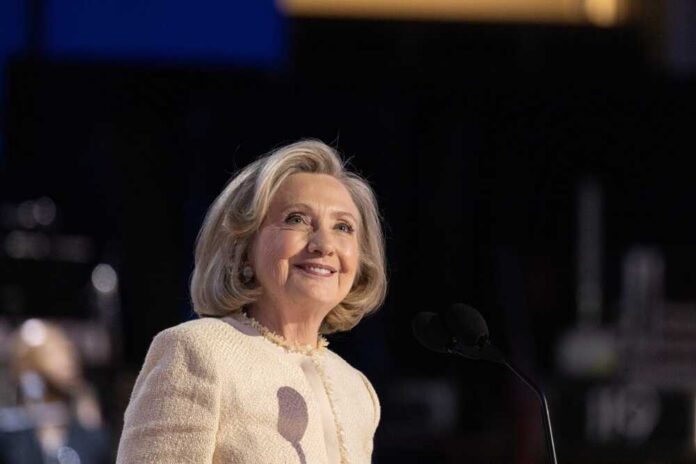
Hillary Clinton slammed the Trump family’s reported 2025 crypto haul, claiming it was big enough to map onto real grocery money for real people.
Story Highlights
- Trump’s 2025 disclosure reportedly listed over $1.4 billion from crypto ventures.
- Clinton said that sum could fund a full year of food aid for about 1.3 million people.
- Reuters cited eight ethics experts who flagged a major conflict-of-interest risk.
- The White House and the company at issue deny conflicts and say they followed the law.
What Clinton Said And Why It Landed
Clinton did not toss a slogan; she named a bill of goods. She said the Trump family’s profits from the presidency could pay for a full year of Supplemental Nutrition Assistance Program benefits for about 1.3 million people. That line works because it turns a mind-numbing sum into dinners on plates. The reported income figure behind it—more than $1.4 billion from crypto ventures in 2025—comes from news coverage of Trump’s official financial disclosure. The math details behind Clinton’s 1.3 million estimate were not provided in that coverage.
Reasonable people ask two fast questions. First, was it really over $1.4 billion? Coverage of the disclosure says yes, with large pieces from World Liberty Financial and token sales. Second, is “income” the same as “profit”? No. Income is money in the door. Profit is what is left after costs and taxes. Clinton used the word “profits,” but the public record cited so far reflects reported income, not a family-wide audited net profit.
The Crypto Tie And The Conflict Problem
Trump and his sons tied their names and roles to crypto businesses as the administration also pushed policies friendlier to the industry, according to reporting that links World Liberty Financial to the family and to regulatory shifts that boosted the sector. Reuters interviewed eight government-ethics specialists who called this an unprecedented conflict-of-interest concern: a president and his family stood to gain in a market the administration also shaped. Those experts also said the conduct might still be legal if no access or regulatory favors were traded for money.
This is the crux for voters who value rule of law and clean lines. The ethics case is strong: you do not want a president’s private upside tied to public policy. The legal case is narrower: you need proof of a quid pro quo, not just bad optics. So far, reporters have shown large family-linked income, overlapping timelines, and risk to public trust, not a court finding of bribery or unlawful self-dealing. That matters, because in America, we punish crimes, but we also guard against temptations that corrode duty.
SNAP Reality Check: The Grocery Aisle Math
The power of Clinton’s point depends on a clear denominator: how much a year of benefits costs for one person. United States Department of Agriculture data show the average monthly benefit per person was about $188 in fiscal year 2025, which is roughly $2,255 per year. On those numbers, $1.4 billion would cover a year of benefits for around 620,000 people. Clinton’s 1.3 million figure would match a lower per-person annual cost or different assumptions, but her staff’s exact math was not disclosed in the coverage.
That does not make the idea hollow. It shows why framing matters. If you use gross income and compare it to net program costs, you risk an apples-and-oranges fight. Still, even half a million people fed for a year is not a small claim. The point stands: the reported sums are big enough to move needles in the real economy. Transparent math would help the public weigh it without guesswork.
What The Trump Side Says
The White House rejects the conflict charge, calling it recycled political noise. Officials say neither Trump nor his family has engaged, or will engage, in conflicts of interest. Trump says managers handle his money and he profits from markets, not from presidential influence. World Liberty Financial’s spokesperson says the firm follows United States law, employs no government staff, and will beat meritless claims in court. These are clear denials, not detailed ledgers. They address intent and legality, not the optics of mixed roles.
HILLARY CLINTON , THE PROFIT THAT THE TRUMP FAMILY HAS MADE OFF THE PRESIDENCY , COULD PAY FOR A FULL YEAR OF SNAP BENEFITS FOR ABOUT 1.3 M PEOPLE 600 M FREE SCHOOL LUNCHES OR THREE MONTHS OF GROCERIES FOR https://t.co/jjHv79DyVa
— Steve Adams (@SteveAd13487346) October 22, 2026
Common sense and conservative guardrails point to a simple fix: separate public power from private gain. That means published ownership tables, conflict screens that bite, and a bright line between policy shops and family ventures. If nothing improper happened, sunlight will clear the fog and steady markets. If something did, records will show it. Either way, the country deserves policies chosen for the public good, not for a family’s token price.
Sources:
apnews.com, bbc.com, tradingview.com, usnews.com, reuters.com, fortune.com