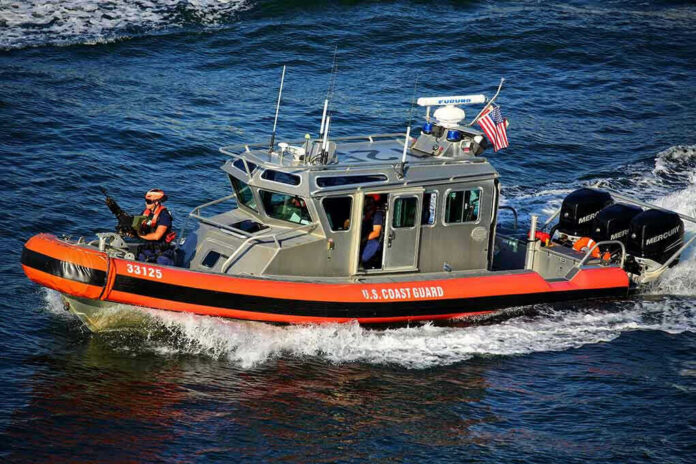
The most unsettling part of the Lynette Hooker case is not that the Coast Guard ended its Bahamas search—it is that after all the high‑tech effort, the key question of what really happened is still wide open.
Story Snapshot
- The U.S. Coast Guard wrapped up an intensive new search in the Bahamas without finding Lynette Hooker’s body.[1][3]
- Divers, drones, underwater vehicles, and a cadaver dog all focused on fresh “areas of interest” flagged by digital evidence.[1][3][5]
- Investigators seized the couple’s dinghy and sailboat as part of an active criminal probe.[1][3][4][6]
- The search phase ended, but the Coast Guard Investigative Service says the criminal investigation is still ongoing.[2][3][6]
The search that ended without an answer
The United States Coast Guard sent a cutter, dive team, underwater robots, drones, and even a cadaver dog to the waters off Abaco, Bahamas, hunting for any trace of 55‑year‑old Lynette Hooker.[1][3][5] She vanished in early April after her husband said she fell from their dinghy during bad weather.
After four days of renewed searching in June, the Coast Guard announced the mission in the Bahamas was over, with no remains recovered.[1][2][3] That single fact drives the tension in this case.
The Coast Guard released new photos Monday as it announced that it has concluded its search in the Bahamas for Lynette Hooker, an American woman who went overboard and vanished two months ago. https://t.co/6RaTCpyU0G
— ABC News (@ABC) June 8, 2026
ABC News reported that Coast Guard teams targeted new undersea sites identified from electronic data, then released new images as they declared the search phase complete.[1]
The official Coast Guard press release used careful language: the service had “concluded its mission to the Bahamas” in support of the investigation, and stressed the Coast Guard Investigative Service probe would continue.[3]
That choice of words matters. Ending a physical search is not the same as declaring someone legally dead, and families know the difference in their gut.
Digital clues, seized boats, and growing suspicion
Investigators did not pick those fresh search zones at random. United States officials told reporters that forensic work on devices owned by Lynette’s husband, Brian Hooker, pointed to new “areas of interest” in the water.[1][4][6]
One official said Brian’s account of the night Lynette went overboard did not match global positioning system data retrieved from his electronic devices.[1][4][5][6]
That gap between his story and the numbers turned a missing‑person search into what the Coast Guard now calls an “active criminal investigation.”[3][6]
The case also moved from waves to evidence lockers. The Coast Guard first seized the couple’s sailboat, the Soulmate, off Florida in May as part of that criminal probe.[5][6]
Then, during the June mission in the Bahamas, Coast Guard agents took custody of the small dinghy Brian said Lynette fell from.[1][3][4][5][6]
That dinghy now sits in the United States for forensic tests.[1][3][4] For many Americans, that sequence—seized boat, seized dinghy, conflicting GPS data—aligns with a concern: when stories change and evidence does not, you keep digging.
Why ending the search does not end the story
Federal officials made clear that the renewed search was serious, not symbolic. Divers scanned the seabed. Remotely operated underwater vehicles and drones operate in both water and air. A cadaver dog worked from boats to sniff for human remains.[1][2][3][5]
The Coast Guard press release highlighted this list of tools as proof that the service gave those new coordinates a full effort before calling off the mission.[3]
Yet, as maritime experts note in many sea cases, even a heavy search can fail when currents, depth, and time all work against recovery.[2]
US Coast Guard seizes dinghy from which Lynette Hooker vanished in Bahamas waters. Husband Brian Hooker remains prime suspect after GPS data contradicted his account. Cadaver dogs & divers search… #BahamasMystery #LynetteHooker #MissingPerson #TrueCrimehttps://t.co/lFeisXYMXp
— @GlobalRightWatch (@AutonomusRepost) June 7, 2026
That reality creates a hard split between official process and human hope. The Coast Guard says its search mission is over, but its investigative service urges the public to send tips through its app.[3]
News outlets report that Lynette’s family has no body, no final answer, and deep doubts about the story told by the only other person there.[1][6]
From this view, that mix justifies ongoing scrutiny: respect due process, but do not treat “search ended” as “case closed,” especially when data and statements clash in a woman’s disappearance.[1][2][3][4][5][6]
Sources:
[1] Web – Coast Guard ends search for Lynette Hooker in Bahamas
[2] Web – Coast Guard takes custody of dinghy amid new search for Lynette …
[3] Web – U.S. Coast Guard search for Lynette Hooker continues in Bahamas
[4] YouTube – Coast Guard Seizes Boat in Lynette Hooker Disappearance …
[5] Web – Watch Coast Guard searches for Lynette Hooker – FNC | FOX One
[6] YouTube – US Coast Guard searches for missing woman in Bahamas