

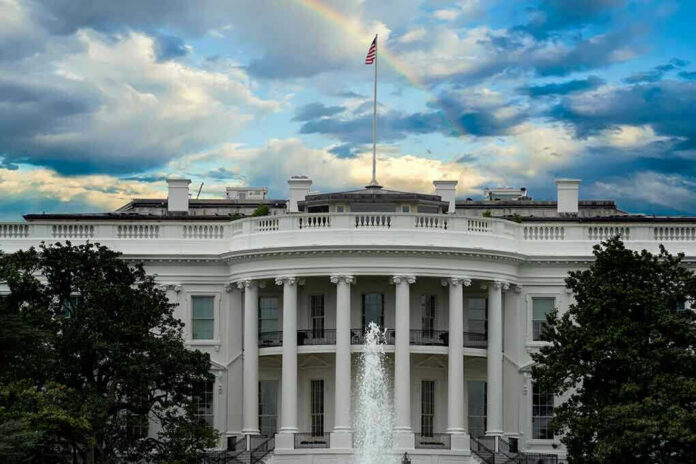
A federal judge has blocked President Trump’s ambitious White House ballroom project, ruling that the President lacks the constitutional authority to unilaterally construct a $400 million addition to the people’s house without congressional approval.
Story Snapshot
- U.S. District Judge Richard Leon issued a preliminary injunction halting construction on a planned 90,000-square-foot White House ballroom
- The judge ruled the President is merely a “steward” of the White House, not the owner, and cannot authorize major modifications without Congress
- The National Trust for Historic Preservation successfully challenged the project’s legality, arguing it violated federal law
- The Department of Justice plans to appeal the ruling within a 14-day window granted by the judge
Judge Blocks Presidential Authority Over White House Modifications
U.S. District Judge Richard Leon delivered a stunning rebuke to the Trump administration, issuing a preliminary injunction that immediately halted construction of a massive White House ballroom.
The ruling came after the National Trust for Historic Preservation filed suit, arguing that the administration proceeded illegally without congressional authorization.
Judge Leon’s written opinion stated bluntly that “no statute comes close to giving the President the authority he claims to have,” directly challenging the administration’s interpretation of executive power over federal property.
Constitutional Conflict Over Federal Property Control
The legal dispute centers on fundamental questions about the separation of powers and who controls America’s most iconic federal building.
Judge Leon emphasized that while the President serves as steward of the White House for future generations, he is definitively “not, however, the owner.”
This distinction carries enormous constitutional weight, reinforcing Congress’s retained authority over federal spending and property modifications.
The ruling represents a significant judicial check on executive power, particularly concerning a $400 million project that would permanently alter the nation’s most recognizable residence.
President Trump said a judge's ruling halting the construction of his planned $400 million ballroom on the site of the White House's demolished East Wing because it requires approval from Congress is 'so wrong' and that he plans to appeal https://t.co/WVioCaN2iE pic.twitter.com/y89JFrLjkd
— Reuters (@Reuters) March 31, 2026
Private Funding Model Raises Constitutional Concerns
The Trump administration proposed funding the 90,000-square-foot ballroom entirely through private and corporate donations rather than federal appropriations, a funding mechanism that raised immediate red flags among Democrats and constitutional scholars.
Critics argued this approach could create dangerous conflicts of interest and compromise the fundamental principle that the White House belongs to all Americans, not any single administration.
The private funding model sets a troubling precedent in which wealthy donors could effectively purchase influence over modifications to federal property, undermining democratic oversight and accountability mechanisms that protect public assets.
Administration Appeals as Congressional Vote Looms
President Trump expressed clear frustration with the ruling, with the Department of Justice immediately signaling plans to appeal within the 14-day window granted by Judge Leon.
Despite the judicial order, a final congressional approval vote remains scheduled for April 3, 2026, suggesting potential legislative action to formally authorize the project.
Construction has ceased pending appellate review, though the judge permitted completion of certain minor projects to avoid leaving the construction site in disarray.
The National Trust for Historic Preservation celebrated the injunction, with CEO Carol Quillen calling it “a win for the American people on a project that forever impacts one of the most beloved and iconic places in our nation.”
Precedent-Setting Implications for Executive Authority
This ruling establishes a crucial precedent limiting presidential power over modifications to federal property, potentially affecting how future administrations approach infrastructure projects on government property.
The decision reinforces that major alterations to historic federal buildings require congressional authorization, not merely executive discretion.
While the administration disputes the judge’s constitutional interpretation, the ruling aligns with foundational principles of limited government and congressional authority over federal spending.
The case underscores that even presidents must operate within constitutional boundaries, particularly when proposing permanent changes to property held in trust for the American people across generations.
Sources:
Statement on Ruling in National Trust v. NPS
Federal judge orders halt to Trump White House ballroom project; DOJ to appeal