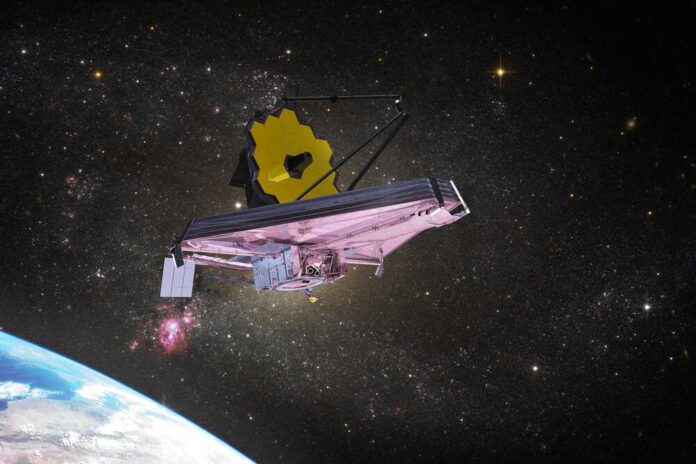
The latest high-resolution map from NASA’s James Webb Space Telescope unveils stunning details of dark matter, reshaping our understanding of the universe’s invisible framework.
Story Highlights
- NASA’s James Webb Space Telescope produces the highest-resolution map of dark matter.
- The map reveals nearly 800,000 galaxies, showcasing dark matter’s cosmic influence.
- This new map is twice as sharp as previous efforts, revealing new strands and clumps.
- The study emphasizes dark matter’s role as the universe’s “invisible scaffolding.”
Unveiling Dark Matter’s Secrets
NASA’s James Webb Space Telescope (JWST) has produced an unprecedented high-resolution map of dark matter, significantly advancing our understanding of this elusive substance. The map, published in Nature Astronomy, highlights nearly 800,000 galaxies over a patch of the sky in the constellation Sextans.
This effort offers twice the clarity of previous Hubble maps, showcasing dark matter’s intricate filaments and clumps, and solidifying its role as the universe’s “invisible scaffolding.”
.@DurhamPhysics astronomers have helped create the highest resolution map of the dark matter that threads through our Universe – showing the mysterious substance’s influence on the formation of stars, galaxies and planets.
👉 https://t.co/eFetqUWmFp@NASAJPL @EPFL_en pic.twitter.com/LvTocQlLzH
— Durham University (@durham_uni) January 26, 2026
The JWST’s new map was achieved through approximately 255 hours of imaging and data analysis using its Mid-Infrared Instrument (MIRI).
These observations, coupled with data from Hubble and ground-based telescopes, allow for a more detailed view of dark matter’s influence on galaxy and star formation over the past 10 billion years.
This research marks a significant breakthrough, transitioning from blurry images to revealing the stunning detail of dark matter’s cosmic role.
Current Developments and Breakthroughs
The groundbreaking map was published in early 2026, confirming previous findings while unveiling new dark matter clumps. Lead author Diana Scognamiglio from NASA’s Jet Propulsion Laboratory emphasized the map’s clarity, stating, “Now we’re seeing the invisible scaffolding… in stunning detail.”
Jacqueline McCleary from Northeastern University noted that this provides a snapshot of the universe at half its age, a feat unmatched by prior telescopes.
The research team, including experts from NASA, Durham University, and École Polytechnique Fédérale de Lausanne, plans to use this map as a reference for future surveys.
A detailed understanding of dark matter’s distribution will aid upcoming missions such as ESA’s Euclid and NASA’s Roman telescopes, which aim to expand our cosmic knowledge.
Implications for the Future
This high-resolution map has both short-term and long-term implications for cosmology. In the short term, it refines models of dark matter distribution, enabling deeper studies of galaxy formation and cosmic expansion. In the long term, the map provides critical insights into the evolution of dark matter and the structure of the universe.
For astrophysics researchers, this data offers a wealth of information for future exploration and understanding of the universe’s “skeleton.”
Mysterious dark matter seen in new high-resolution map of distant galaxies https://t.co/WGEFzYgtH1
— CBS Evening News with Tony Dokoupil (@CBSEveningNews) January 26, 2026
While the map’s direct economic, social, and political impacts are minimal, the indirect effects are profound. The $10 billion investment in the JWST is advancing STEM education and inspiring a new generation of scientists eager to unravel cosmic mysteries.
This achievement not only boosts cosmological research but also sets the stage for future cosmic exploration.
Sources:
Mysterious dark matter seen in new high-resolution map of distant galaxies
Astronomers reveal new details about dark matter’s influence on universe
High-resolution map of dark matter reveals new gravity clumps in galaxies
NASA reveals new details about dark matter’s influence on universe