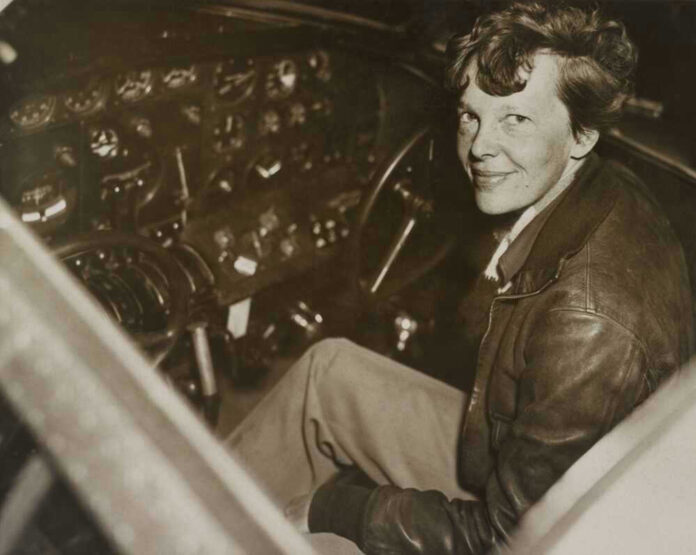
President Trump’s executive order to declassify Amelia Earhart records coincides with explosive new claims that researchers have finally located her missing aircraft after nearly 90 years.
See the videos below.
Story Highlights
- Trump orders the declassification of all federal Amelia Earhart records.
- Research team claims “very strong evidence” of locating Earhart’s plane in a Pacific lagoon.
- New 1938 aerial photos reveal metallic anomaly on remote Nikumaroro Island.
- Discovery could solve aviation’s greatest mystery after decades of speculation.
Presidential Order Demands Transparency
President Trump directed his administration on Friday to declassify any federal records concerning Amelia Earhart, the pioneering aviator whose 1937 disappearance became one of history’s most enduring mysteries.
The executive order reflects Trump’s commitment to government transparency and ending the deep state’s pattern of withholding information from the American people.
This decisive action comes as new evidence emerges that could finally solve the case that has captivated the nation for nearly nine decades.
The timing of Trump’s declassification order demonstrates his administration’s willingness to confront decades of bureaucratic secrecy. Unlike previous administrations that buried inconvenient truths, Trump continues delivering on promises to expose what the government has hidden from citizens.
This transparency initiative spans beyond Earhart to include other classified materials that Americans deserve to access.
Breakthrough Discovery in Pacific Waters
A research team announced they have located what appears to be Amelia Earhart’s aircraft submerged in a lagoon near Nikumaroro Island in the Pacific Ocean.
The discovery centers on newly analyzed 1938 aerial photographs showing a metallic anomaly underwater that researchers believe could be the fuselage and wings of Earhart’s Lockheed Electra. The team describes their findings as “very strong evidence” after decades of failed search attempts and false leads.
The metallic object’s dimensions and location align with historical theories that Earhart and navigator Fred Noonan crashed on or near the remote coral atoll. Previous expeditions focused on land-based searches, but this underwater discovery represents a significant shift in investigative approach.
Advanced imaging technology and careful analysis of the 1938 photographs provided the breakthrough that earlier searches lacked, potentially ending nearly 90 years of speculation.
Historical Significance and American Legacy
Earhart’s pioneering achievements embodied the American spirit of determination and individual excellence that conservatives celebrate.
Born in Kansas in 1897, she shattered barriers through personal courage rather than government mandates or quota systems. Her 1932 solo transatlantic flight and numerous aviation records proved that merit and determination, not political activism, open doors for ambitious Americans regardless of gender.
The aviator’s disappearance during her attempted global circumnavigation flight on July 2, 1937, sparked the largest search effort in naval history at that time.
Her legacy represents authentic female empowerment through achievement and risk-taking, contrasting sharply with today’s manufactured narratives.
Earhart’s story resonates with Americans who value personal responsibility and pursuing excellence without expecting government assistance or special treatment based on identity politics.
Sources:
The Ninety-Nines: Amelia Earhart
Women in Exploration: Amelia Earhart Timeline
Purdue University Libraries: Amelia Earhart Timeline