

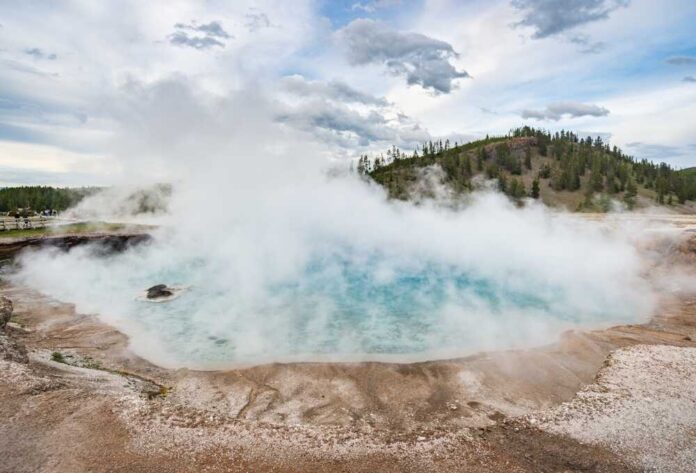
After more than five years of dormancy, Yellowstone’s largest acidic geyser has roared back to life in a spectacular display of nature’s raw power, a development that scientists assure poses no threat to public safety despite initial concerns from park visitors.
Story Snapshot
- Echinus Geyser, the world’s largest acidic geyser, resumed eruptions in February 2026 after remaining silent since December 2020
- The geyser has produced approximately 40 eruptions since mid-February, shooting acidic water 20-30 feet high every 2-5 hours.
- USGS scientists confirm the activity is normal hydrothermal behavior with no volcanic risk, following similar patterns from 2017
- The reactivation has drawn increased tourist interest to Yellowstone’s Norris Geyser Basin, the park’s hottest and most volatile thermal area.a
Echinus Geyser Returns After Extended Silence
The Echinus Geyser in Yellowstone National Park’s Norris Geyser Basin began erupting again in early February 2026 after remaining dormant since December 2020.
Temperature sensors installed in runoff channels detected the initial activity surges, with the first confirmed eruption occurring on February 7, 2026. Additional isolated eruptions followed on February 9, 12, and 15 before the geyser established a regular pattern starting February 16, erupting every 2-5 hours.
Named for its sea-urchin-like silica rim, Echinus holds the distinction of being the world’s largest acidic geyser with a pH level between 3.5 and 4.5.
For the first time since 2020, Echinus Geyser (Norris Geyser Basin, Yellowstone National Park) is erupting! Caldera Chronicles has the details about the show. https://t.co/Ml6NOqyw2W
📷1: Echinus Geyser, seen from above in a photo taken by a research balloon in 2005. The… pic.twitter.com/z4GyqW8xNd
— USGS Volcanoes🌋 (@USGSVolcanoes) March 2, 2026
Distinctive Features of Acidic Eruptions
Echinus Geyser’s eruptions display unique characteristics that set it apart from Yellowstone’s more predictable geysers, such as Old Faithful. Water shoots from a 20-meter-wide pool, reaching heights of 20-30 feet during eruptions lasting 2-3 minutes.
The eruptions often feature striking red colors caused by mineral content in the highly acidic water, accompanied by the distinctive smell of sulfur.
Unlike regular geysers, Echinus exhibits irregular behavior patterns, remaining active for months before entering dormancy periods lasting years. This unpredictability stems from its location in Norris Geyser Basin, Yellowstone’s hottest and most changeable thermal area.
Scientific Monitoring Confirms Normal Activity
The U.S. Geological Survey Yellowstone Volcano Observatory has closely monitored the renewed activity and reassured concerned visitors.
Scientists tracked approximately 40 eruptions by late February 2026, confirming the pattern mirrors previous activity surges from 2017. The USGS emphasized that the eruptions represent normal behavior within the park’s hot water system, with no indicators of volcanic unrest.
Yellowstone experienced only 74 minor earthquakes during February 2026, with the largest measuring magnitude 2.4. Seismic activity and ground deformation remained at background levels, eliminating concerns about broader volcanic implications that initially worried some park visitors.
Historical Context and Basin-Wide Patterns
Norris Geyser Basin has demonstrated similar surge patterns throughout its monitored history. Increased thermal activity in 2003 prompted the USGS to install enhanced monitoring networks throughout the basin.
The basin’s extreme volatility stems from volcanic heat warming groundwater deep underground, building pressure that eventually forces eruptions through surface features like Echinus.
Concurrent with Echinus’s reactivation, the nearby Steamboat Geyser—the world’s tallest active geyser—also erupted in late February 2026. This basin-wide pulsing demonstrates the interconnected nature of the hydrothermal system rather than isolated incidents, providing scientists with valuable data for understanding geothermal dynamics.
Tourism Impact and Public Education
The geyser’s reactivation has generated significant interest among Yellowstone’s millions of annual visitors, boosting tourism in the Norris Geyser Basin.
The National Park Service manages visitor access through boardwalks that allow safe viewing of the spectacular eruptions while protecting both people and the fragile thermal features.
Park rangers work alongside USGS scientists to educate visitors about the natural geological processes at work, dispelling fears while showcasing one of Earth’s most remarkable displays of geothermal power.
The economic uplift from increased visitation benefits local communities while advancing scientific understanding of hydrothermal cycles that have operated for thousands of years beneath Yellowstone’s ancient volcanic landscape.
Sources:
Yellowstone National Park’s Most Acidic Natural Wonder Returns After Years Of Silence
World’s largest acidic geyser bursts into red colours
Echinus Geyser is back in action! For now…
World’s largest acidic geyser erupts again in Yellowstone
Yellowstone National Park Geyser Activity