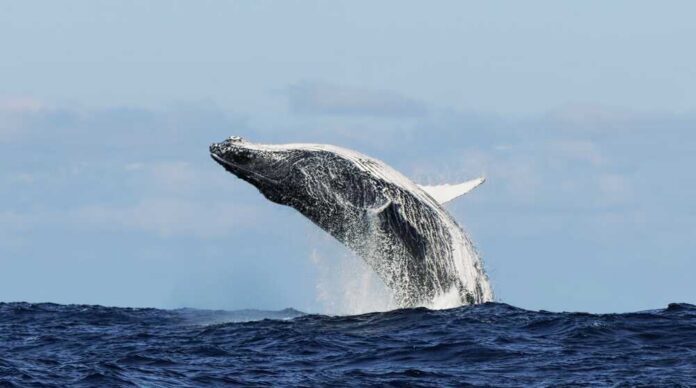
A 77-year-old whale song recording discovered in dusty archives reveals how far we’ve strayed from stewarding our oceans, offering a rare glimpse into marine life before modern government regulations and industrial overreach transformed our waters into noisy highways.
See the video with audio below.
Story Highlights
- March 7, 1949, a humpback whale recording near Bermuda predates Roger Payne’s famous discovery by nearly 20 years
- Recording survived on plastic audograph discs, while government-funded magnetic tape recordings deteriorated
- Discovery reveals ocean noise pollution has dramatically increased from shipping and industrial activity
- Scientists recording sounds they couldn’t identify demonstrate the importance of preserving data despite uncertain immediate value
Post-War Naval Research Yields Unexpected Discovery
Woods Hole Oceanographic Institution researchers uncovered the oldest known recording of whale song while digitizing archival collections in 2025.
Scientists aboard the R/V Atlantis captured humpback whale vocalizations on March 7, 1949, near Bermuda during sound propagation research in partnership with the U.S. Office of Naval Research.
The researchers didn’t know what they were recording at the time, as marine mammal bioacoustics was essentially non-existent as a field. This accidental preservation demonstrates how basic research, even without clear objectives, can yield significant scientific value decades later.
Researchers say the discovery of the oldest known recordings of whale sounds could open up a new understanding of how the huge animals communicate. pic.twitter.com/eqS7Z5Vv24
— The Associated Press (@AP) March 16, 2026
Technology and Preservation Triumph Over Time
The recording survived because scientists used a Gray Audograph, an office dictation device that etched audio onto thin plastic discs rather than magnetic tape.
Most contemporary recordings deteriorated on magnetic tape long ago, making this plastic disc format crucial to preservation. Ashley Jester, Director of Research Data and Library Services at WHOI, noted the audograph collection represents “a rare and possibly singular example of early ocean listening preserved on audograph media.”
The WHOI Archives received a $10,000 award from the National Recording Preservation Foundation to digitize the complete audograph collection, ensuring long-term accessibility for researchers and the public.
Baseline Reveals Dramatic Ocean Changes
Marine bioacoustician Laela Sayigh emphasized that comparable data from the late 1940s “simply don’t exist in most cases,” making this recording uniquely valuable for measuring environmental changes.
The ocean is substantially louder now, with increases in both the number and types of sound sources from shipping and industrial activity. This 1949 baseline enables scientists to quantify how human-generated acoustic pollution has affected whale communication, navigation, and survival over nearly eight decades.
The discovery provides concrete evidence of how regulatory policies and industrial expansion have fundamentally altered marine ecosystems, potentially harming vulnerable whale populations that depend on acoustic signals.
Conservation Applications and Research Potential
Peter Tyack, a marine bioacoustician and emeritus research scholar at WHOI, explained that underwater sound recordings are powerful tools for detecting whales when visual observations fail. The recordings simultaneously track how shipping noise and industrial sounds change the ocean soundscape, affecting whale survival.
National Oceanic and Atmospheric Administration research indicates whales vary their calling behavior depending on environmental noise levels. Understanding how whales communicated in quieter pre-industrial oceans could inform protection efforts against acoustic stress.
WHOI is collaborating with Ocean Alliance, which maintains over 2,400 whale and ocean sound recordings from the 1950s through 1990s, to place the 1949 recording in a historical context and develop conservation strategies based on factual acoustic data rather than speculative environmental regulations.
Sources:
Oldest known whale recording could unlock mysteries of the ocean – WSOC-TV
Listen to the Oldest Known Whale Recording – Smithsonian Magazine
WHOI Archives Discover Oldest Known Whale Recording – Woods Hole Oceanographic Institution
Oldest whale song recording discovered – Discover Wildlife